Letter From the Editor in Chief
Dear Badminton Enthusiasts,
The Summer Olympic Games are among humanity's greatest shared traditions. Every four years, they unite nations and generations around an exacting ideal: excellence pursued with courage, rivalry joined with respect, and human possibility tested before the world. Medals record results, but the Games endure because they reveal the work, sacrifice, and belief behind one extraordinary moment.
Badminton's Olympic journey reflects that persistence. It appeared as a demonstration sport in Munich in 1972, returned as an exhibition event in Seoul in 1988, and became a medal sport in Barcelona in 1992. The Badminton World Federation has cited 339 million active participants worldwide, a reminder that few sports can feel so welcoming in a neighborhood gym and so breathtaking on the Olympic stage.
At Manhattan Beach Badminton Club, Olympic history has never felt distant. Founded in 1936, our club has spent generations developing players and building community. A photograph of the inaugural U.S. Olympic badminton team from Barcelona still hangs on our wall. Joy Kitzmiller, developed through MBBC, was part of that team; near our entrance is her signed photograph with President George H. W. Bush and First Lady Barbara Bush. Visits from champions such as Viktor Axelsen further connect the youngest player on our courts to badminton's larger story.
Jennie Gai holds a special place in this issue. She was the first athlete to accept our interview request, and her trust gave the project its beginning. When I was very young, I watched Jennie play against my older sister and realized that there was always another level beyond the badminton I knew. Her speed, timing, and composure made excellence seem almost unreal. Years later, I admire not only her talent, but also the discipline required to balance elite international badminton with the academic demands of UC Berkeley. Only Jennie can fully know the sacrifices behind that balance, but her persistence carried her to Paris.
The athletes and coach who follow reveal other forms of courage. Beiwen Zhang built a world-class career with remarkable independence. Annie and Kerry Xu returned from established professional lives, climbed from outside the top 500 into the top 50, and reached Paris together. Vinson Chiu shows how doubles excellence grows through communication and trust, while Joshua Yuan turned a distant goal into daily discipline. Jayci Simon and Miles Krajewski created practice space where none existed, then earned Team USA's first Paralympic badminton medal. Michelle Li has pursued excellence through years of uncertainty, and Abhishek Ahlawat reminds us that access, mentorship, and community are part of every athlete's success.
Every Olympian and Paralympian in these pages deserves our admiration. Their paths differ, but the spirit is shared: early mornings, difficult choices, loyal partnerships, respect for opponents, and the decision to rise again. Paris did not create their character. It gave the world a place to witness what years of unseen work had already built.
To every athlete and coach who trusted us, thank you. To every interviewer and editor, thank you for listening carefully and preserving each voice. Special thanks to Oliver Chen of Stanford University and Team Canada, who interviewed Michelle Li while balancing competition and academics. To the families, clubs, volunteers, and supporters behind these journeys, thank you for making dreams possible long before the world was watching.
As the Games move from Paris toward Los Angeles, may these stories remind us why badminton matters: it teaches us to compete with honor, trust the person beside us, and leave the path wider for those who follow.
Beyond the net, beyond limits!
Warm regards,
Editor in Chief
Hao Lin
Source: Badminton World Federation (2021), 339 million active participants worldwide.
Olympic Voices
Unconventional Greatness
The Unscripted Rise of Beiwen Zhang
By Rachel Liao
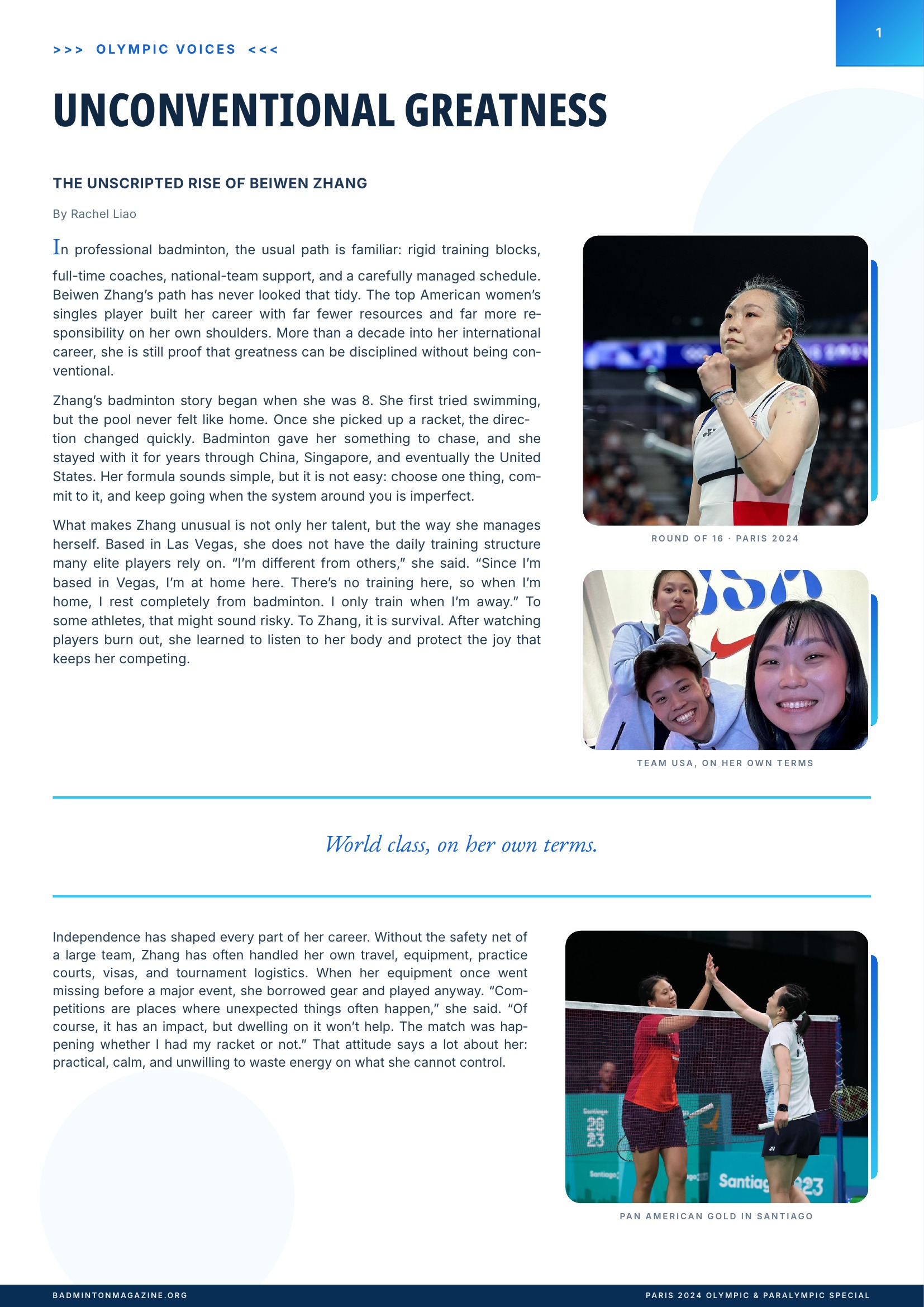
In professional badminton, the usual path is familiar: rigid training blocks, full-time coaches, national-team support, and a carefully managed schedule. Beiwen Zhang's path has never looked that tidy. The top American women's singles player built her career with far fewer resources and far more responsibility on her own shoulders. More than a decade into her international career, she is still proof that greatness can be disciplined without being conventional.
Zhang's badminton story began when she was 8. She first tried swimming, but the pool never felt like home. Once she picked up a racket, the direction changed quickly. Badminton gave her something to chase, and she stayed with it for years through China, Singapore, and eventually the United States. Her formula sounds simple, but it is not easy: choose one thing, commit to it, and keep going when the system around you is imperfect.
What makes Zhang unusual is not only her talent, but the way she manages herself. Based in Las Vegas, she does not have the daily training structure many elite players rely on. "I'm different from others," she said. "Since I'm based in Vegas, I'm at home here. There's no training here, so when I'm home, I rest completely from badminton. I only train when I'm away." To some athletes, that might sound risky. To Zhang, it is survival. After watching players burn out, she learned to listen to her body and protect the joy that keeps her competing.
World class, on her own terms.
Independence has shaped every part of her career. Without the safety net of a large team, Zhang has often handled her own travel, equipment, practice courts, visas, and tournament logistics. When her equipment once went missing before a major event, she borrowed gear and played anyway. "Competitions are places where unexpected things often happen," she said. "Of course, it has an impact, but dwelling on it won't help. The match was happening whether I had my racket or not." That attitude says a lot about her: practical, calm, and unwilling to waste energy on what she cannot control.
Control What You Can
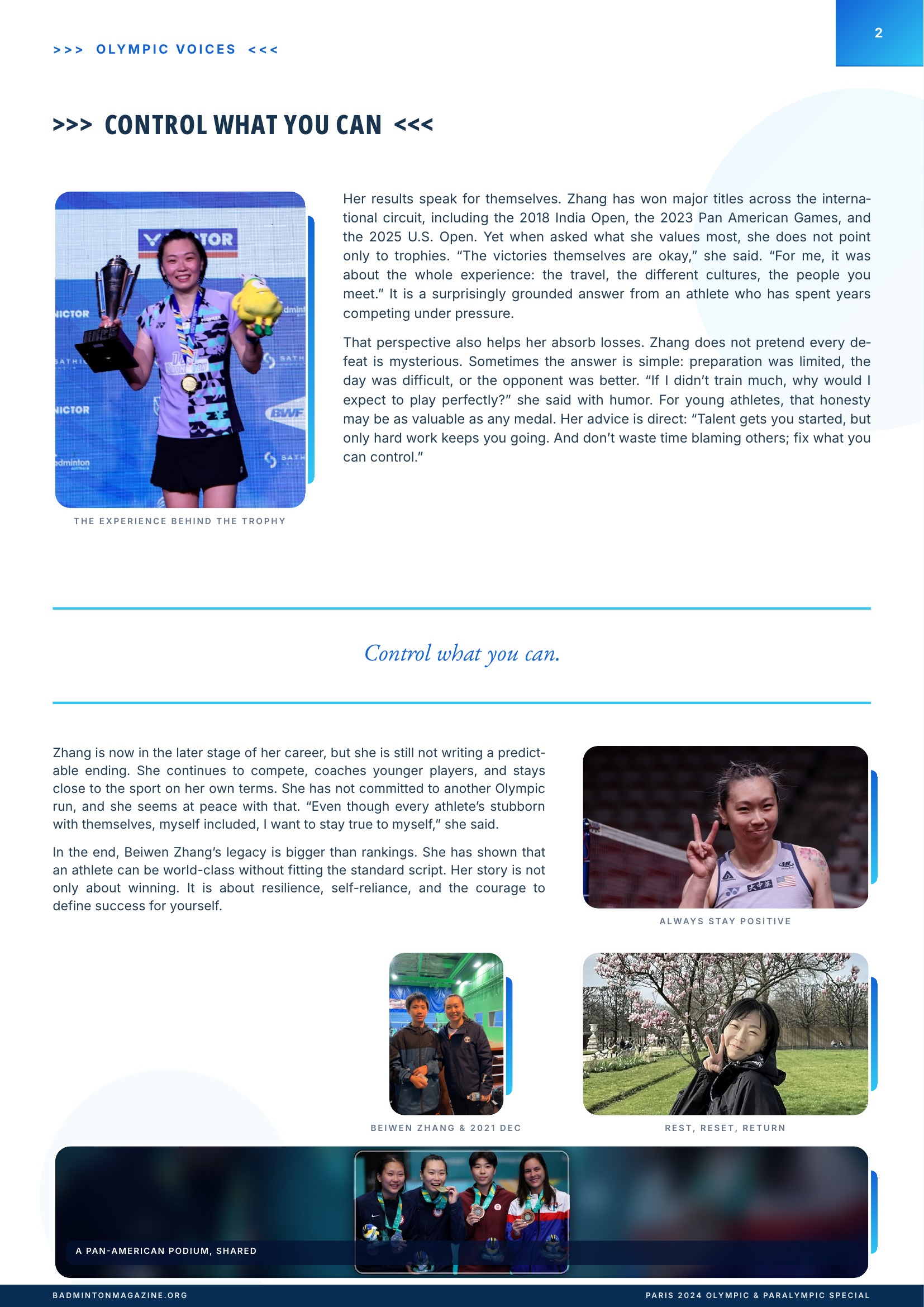
Her results speak for themselves. Zhang has won major titles across the international circuit, including the 2018 India Open, the 2023 Pan American Games, and the 2025 U.S. Open. Yet when asked what she values most, she does not point only to trophies. "The victories themselves are okay," she said. "For me, it was about the whole experience: the travel, the different cultures, the people you meet." It is a surprisingly grounded answer from an athlete who has spent years competing under pressure.
That perspective also helps her absorb losses. Zhang does not pretend every defeat is mysterious. Sometimes the answer is simple: preparation was limited, the day was difficult, or the opponent was better. "If I didn't train much, why would I expect to play perfectly?" she said with humor. For young athletes, that honesty may be as valuable as any medal. Her advice is direct: "Talent gets you started, but only hard work keeps you going. And don't waste time blaming others; fix what you can control."
Control what you can.
Zhang is now in the later stage of her career, but she is still not writing a predictable ending. She continues to compete, coaches younger players, and stays close to the sport on her own terms. She has not committed to another Olympic run, and she seems at peace with that. "Even though every athlete's stubborn with themselves, myself included, I want to stay true to myself," she said.
In the end, Beiwen Zhang's legacy is bigger than rankings. She has shown that an athlete can be world-class without fitting the standard script. Her story is not only about winning. It is about resilience, self-reliance, and the courage to define success for yourself.
Olympic Voices
Chasing Dreams
Jennie Gai — One Shuttle at a Time
By Hao Lin
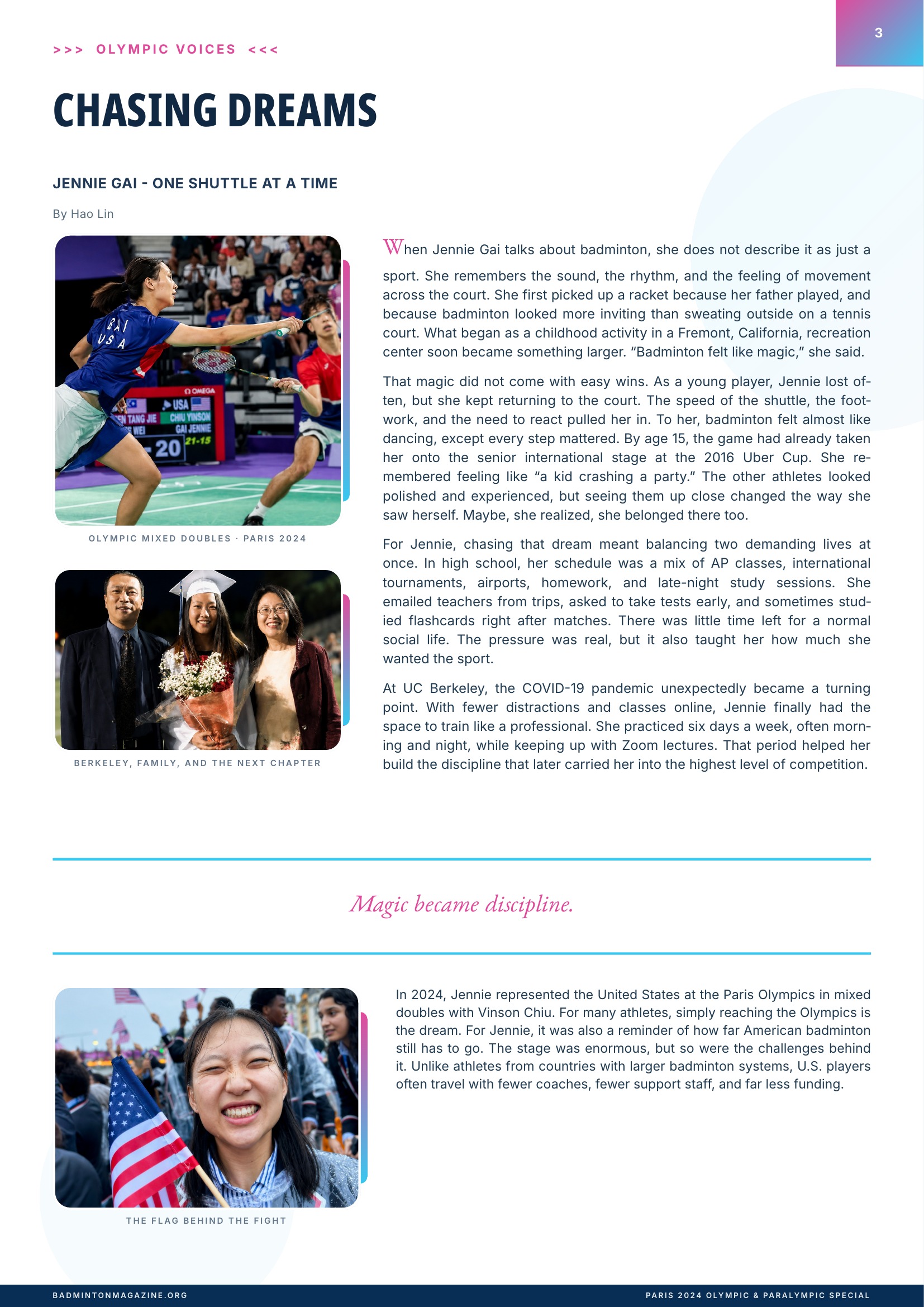
When Jennie Gai talks about badminton, she does not describe it as just a sport. She remembers the sound, the rhythm, and the feeling of movement across the court. She first picked up a racket because her father played, and because badminton looked more inviting than sweating outside on a tennis court. What began as a childhood activity in a Fremont, California, recreation center soon became something larger. "Badminton felt like magic," she said.
That magic did not come with easy wins. As a young player, Jennie lost often, but she kept returning to the court. The speed of the shuttle, the footwork, and the need to react pulled her in. To her, badminton felt almost like dancing, except every step mattered. By age 15, the game had already taken her onto the senior international stage at the 2016 Uber Cup. She remembered feeling like "a kid crashing a party." The other athletes looked polished and experienced, but seeing them up close changed the way she saw herself. Maybe, she realized, she belonged there too.
For Jennie, chasing that dream meant balancing two demanding lives at once. In high school, her schedule was a mix of AP classes, international tournaments, airports, homework, and late-night study sessions. She emailed teachers from trips, asked to take tests early, and sometimes studied flashcards right after matches. There was little time left for a normal social life. The pressure was real, but it also taught her how much she wanted the sport.
At UC Berkeley, the COVID-19 pandemic unexpectedly became a turning point. With fewer distractions and classes online, Jennie finally had the space to train like a professional. She practiced six days a week, often morning and night, while keeping up with Zoom lectures. That period helped her build the discipline that later carried her into the highest level of competition.
Magic became discipline.
In 2024, Jennie represented the United States at the Paris Olympics in mixed doubles with Vinson Chiu. For many athletes, simply reaching the Olympics is the dream. For Jennie, it was also a reminder of how far American badminton still has to go. The stage was enormous, but so were the challenges behind it. Unlike athletes from countries with larger badminton systems, U.S. players often travel with fewer coaches, fewer support staff, and far less funding.
Learning to Fight
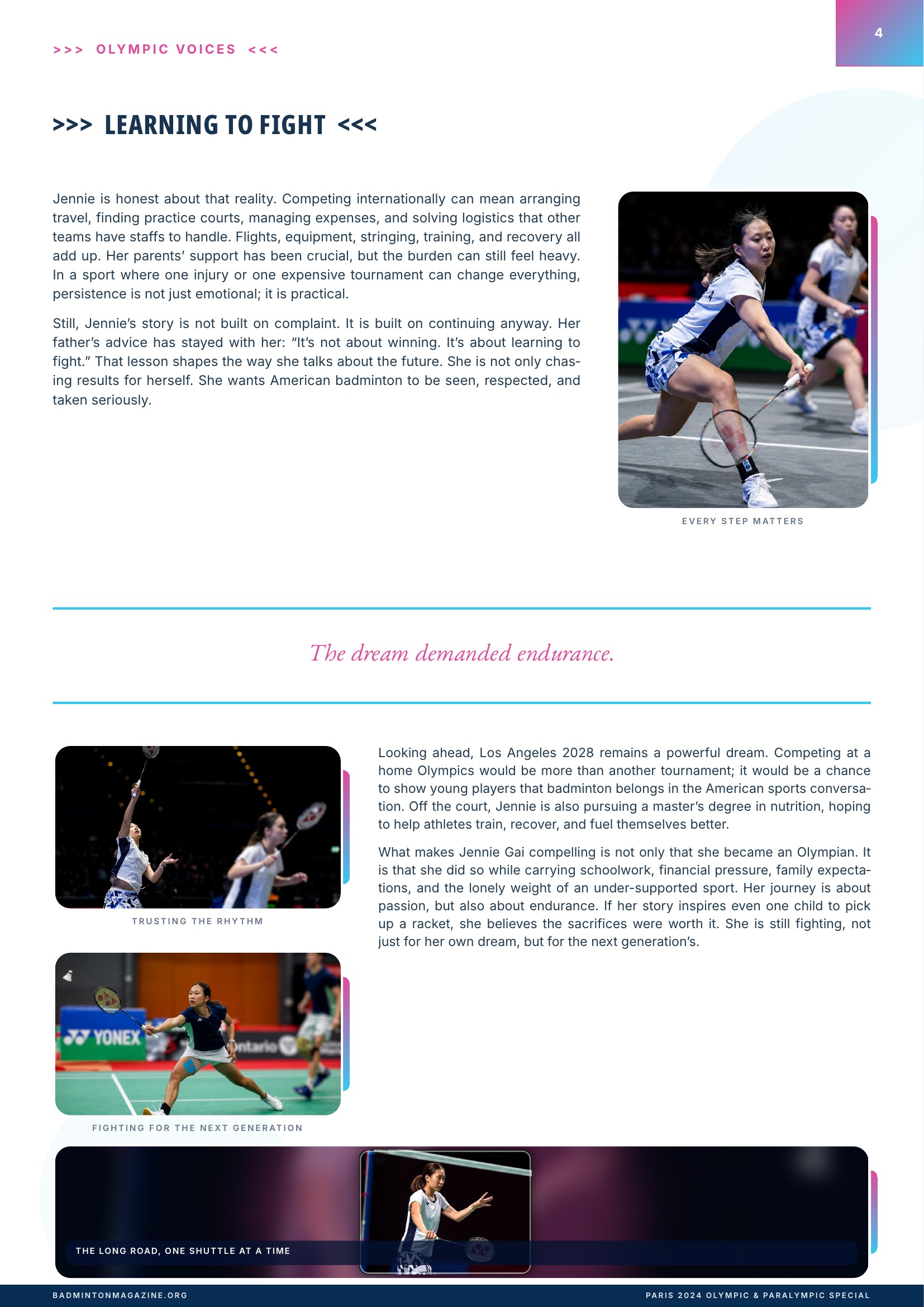
Jennie is honest about that reality. Competing internationally can mean arranging travel, finding practice courts, managing expenses, and solving logistics that other teams have staffs to handle. Flights, equipment, stringing, training, and recovery all add up. Her parents' support has been crucial, but the burden can still feel heavy. In a sport where one injury or one expensive tournament can change everything, persistence is not just emotional; it is practical.
Still, Jennie's story is not built on complaint. It is built on continuing anyway. Her father's advice has stayed with her: "It's not about winning. It's about learning to fight." That lesson shapes the way she talks about the future. She is not only chasing results for herself. She wants American badminton to be seen, respected, and taken seriously.
The dream demanded endurance.
Looking ahead, Los Angeles 2028 remains a powerful dream. Competing at a home Olympics would be more than another tournament; it would be a chance to show young players that badminton belongs in the American sports conversation. Off the court, Jennie is also pursuing a master's degree in nutrition, hoping to help athletes train, recover, and fuel themselves better.
What makes Jennie Gai compelling is not only that she became an Olympian. It is that she did so while carrying schoolwork, financial pressure, family expectations, and the lonely weight of an under-supported sport. Her journey is about passion, but also about endurance. If her story inspires even one child to pick up a racket, she believes the sacrifices were worth it. She is still fighting, not just for her own dream, but for the next generation's.
Olympic Voices
Double the Dream
Twins Achieve Olympic Glory
By Andy Zhang
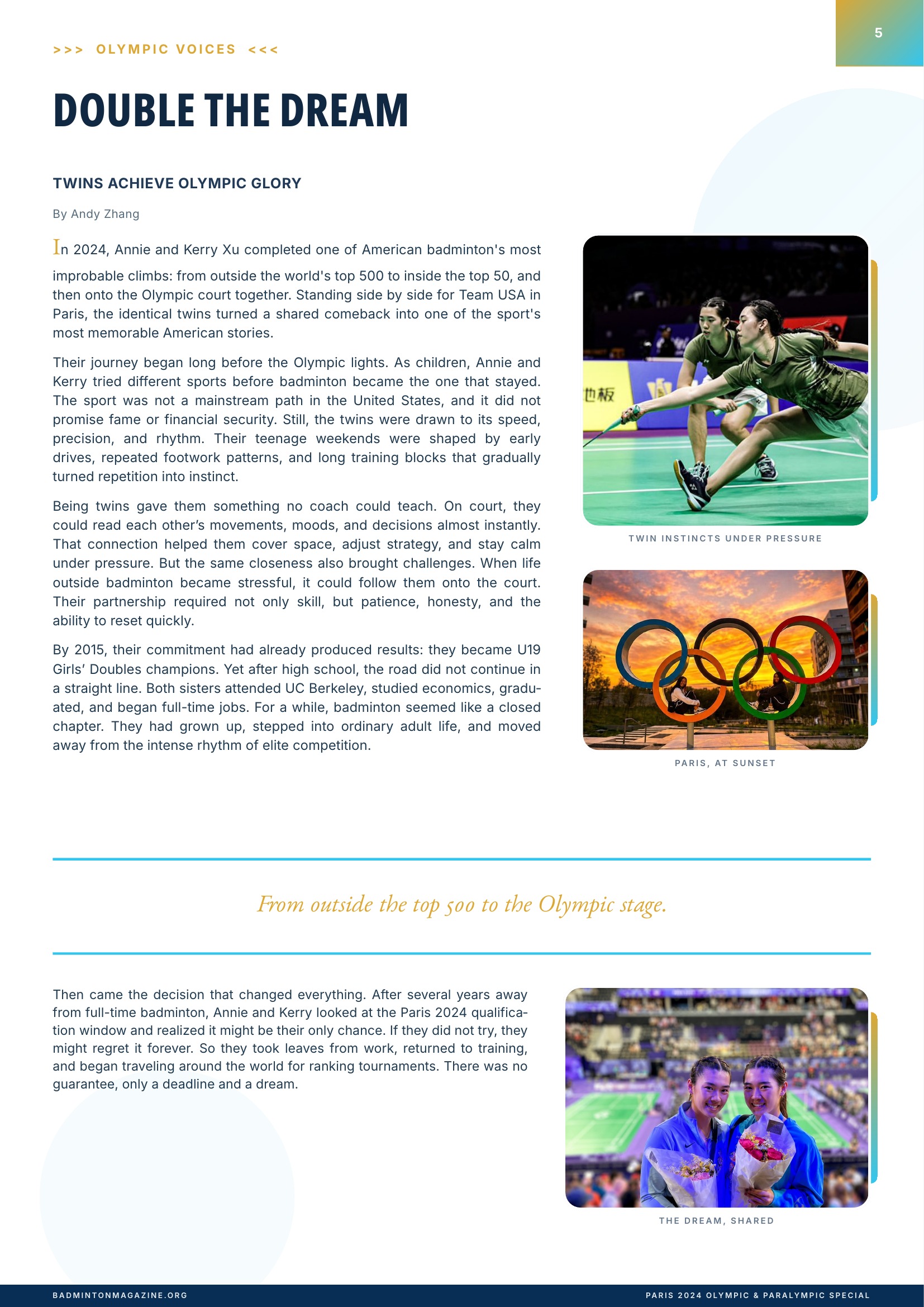
In 2024, Annie and Kerry Xu completed one of American badminton's most improbable climbs: from outside the world's top 500 to inside the top 50, and then onto the Olympic court together. Standing side by side for Team USA in Paris, the identical twins turned a shared comeback into one of the sport's most memorable American stories.
Their journey began long before the Olympic lights. As children, Annie and Kerry tried different sports before badminton became the one that stayed. The sport was not a mainstream path in the United States, and it did not promise fame or financial security. Still, the twins were drawn to its speed, precision, and rhythm. Their teenage weekends were shaped by early drives, repeated footwork patterns, and long training blocks that gradually turned repetition into instinct.
Being twins gave them something no coach could teach. On court, they could read each other's movements, moods, and decisions almost instantly. That connection helped them cover space, adjust strategy, and stay calm under pressure. But the same closeness also brought challenges. When life outside badminton became stressful, it could follow them onto the court. Their partnership required not only skill, but patience, honesty, and the ability to reset quickly.
By 2015, their commitment had already produced results: they became U19 Girls' Doubles champions. Yet after high school, the road did not continue in a straight line. Both sisters attended UC Berkeley, studied economics, graduated, and began full-time jobs. For a while, badminton seemed like a closed chapter. They had grown up, stepped into ordinary adult life, and moved away from the intense rhythm of elite competition.
From outside the top 500 to the Olympic stage.
Then came the decision that changed everything. After several years away from full-time badminton, Annie and Kerry looked at the Paris 2024 qualification window and realized it might be their only chance. If they did not try, they might regret it forever. So they took leaves from work, returned to training, and began traveling around the world for ranking tournaments. There was no guarantee, only a deadline and a dream.
A Second Chance
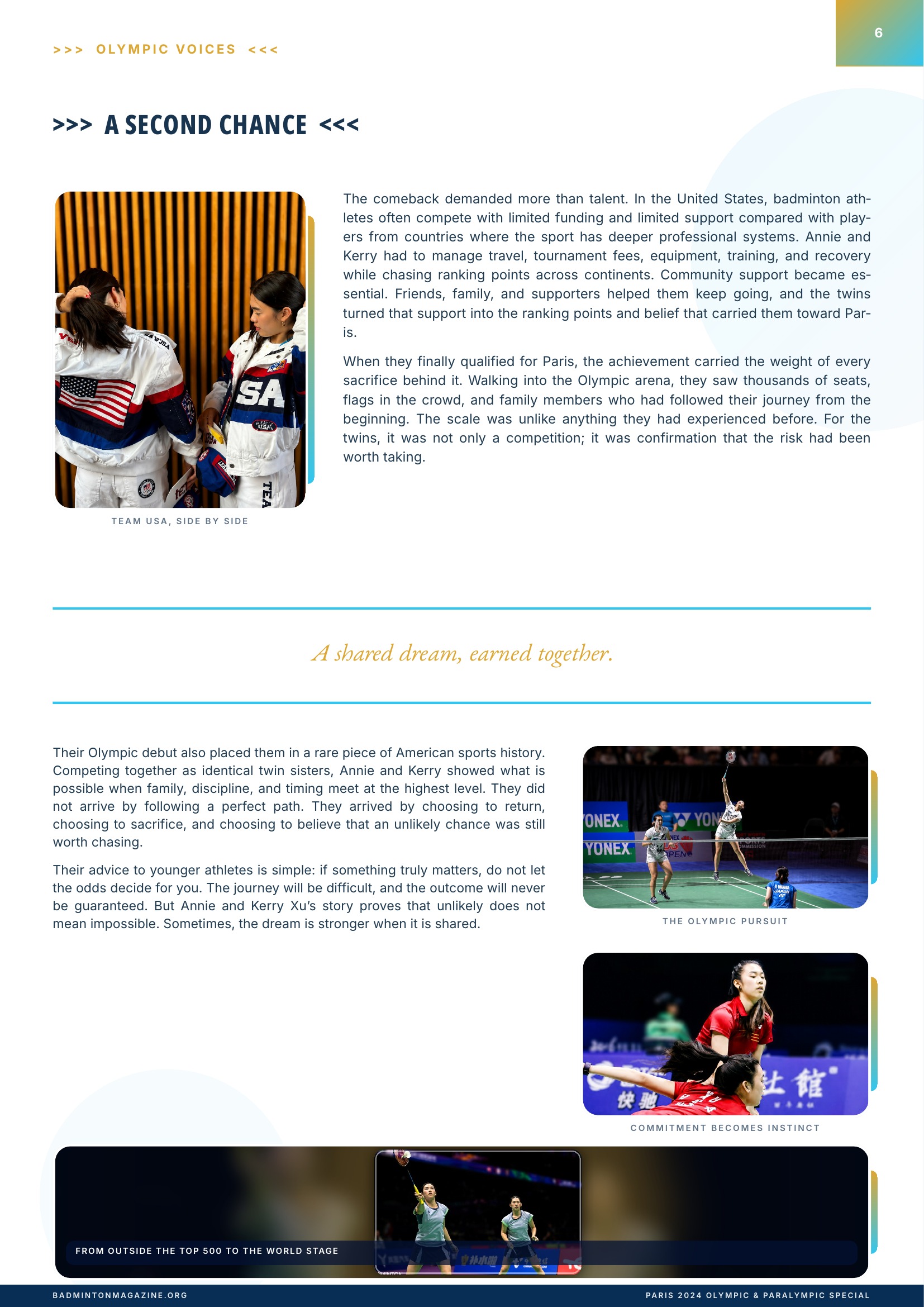
The comeback demanded more than talent. In the United States, badminton athletes often compete with limited funding and limited support compared with players from countries where the sport has deeper professional systems. Annie and Kerry had to manage travel, tournament fees, equipment, training, and recovery while chasing ranking points across continents. Community support became essential. Friends, family, and supporters helped them keep going, and the twins turned that support into the ranking points and belief that carried them toward Paris.
When they finally qualified for Paris, the achievement carried the weight of every sacrifice behind it. Walking into the Olympic arena, they saw thousands of seats, flags in the crowd, and family members who had followed their journey from the beginning. The scale was unlike anything they had experienced before. For the twins, it was not only a competition; it was confirmation that the risk had been worth taking.
A shared dream, earned together.
Their Olympic debut also placed them in a rare piece of American sports history. Competing together as identical twin sisters, Annie and Kerry showed what is possible when family, discipline, and timing meet at the highest level. They did not arrive by following a perfect path. They arrived by choosing to return, choosing to sacrifice, and choosing to believe that an unlikely chance was still worth chasing.
Their advice to younger athletes is simple: if something truly matters, do not let the odds decide for you. The journey will be difficult, and the outcome will never be guaranteed. But Annie and Kerry Xu's story proves that unlikely does not mean impossible. Sometimes, the dream is stronger when it is shared.
Olympic Voices
Beyond the Shuttle
Vinson Chiu's Journey of Resilience, Partnership, and Olympic Purpose
By Coco Tao
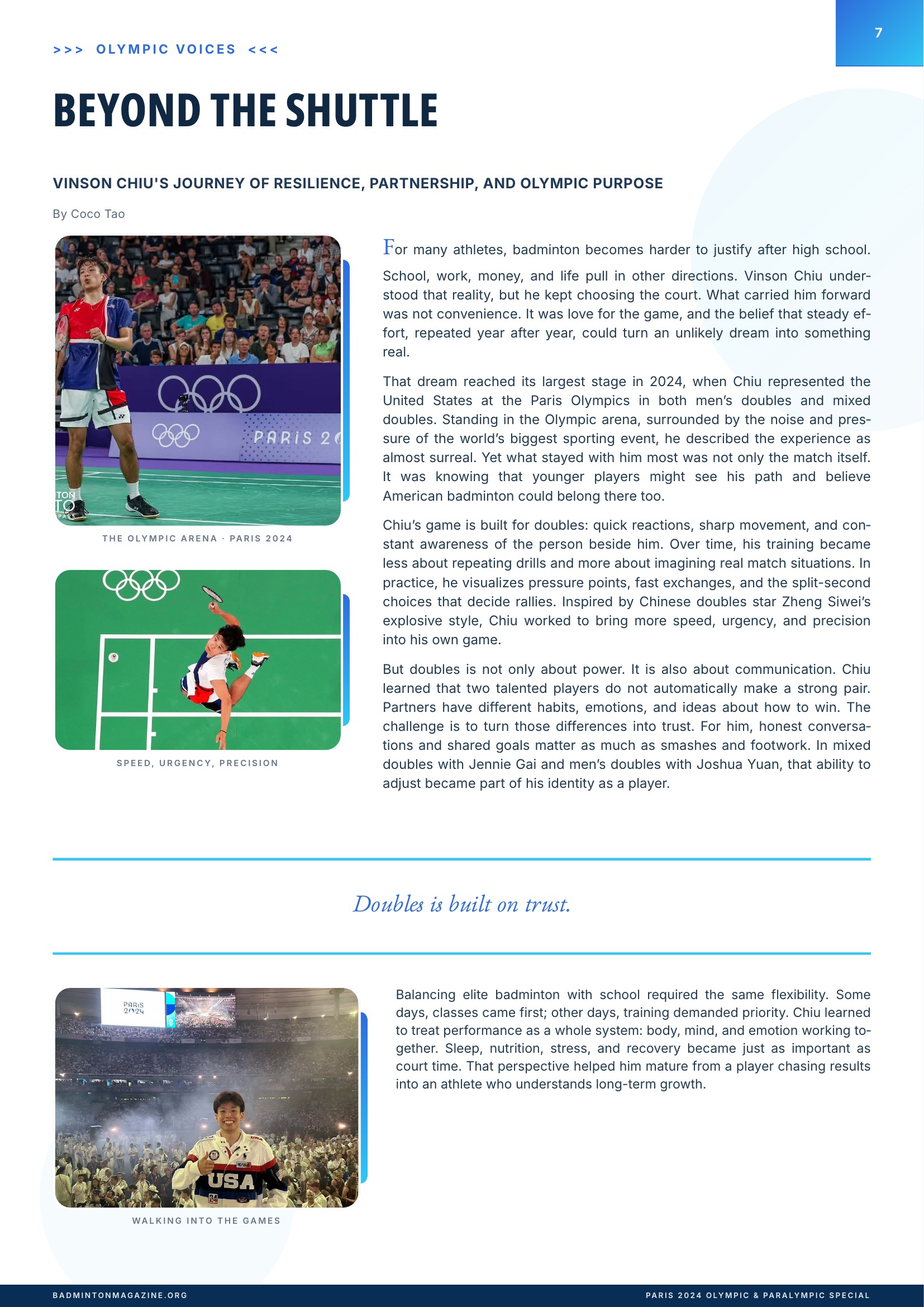
For many athletes, badminton becomes harder to justify after high school. School, work, money, and life pull in other directions. Vinson Chiu understood that reality, but he kept choosing the court. What carried him forward was not convenience. It was love for the game, and the belief that steady effort, repeated year after year, could turn an unlikely dream into something real.
That dream reached its largest stage in 2024, when Chiu represented the United States at the Paris Olympics in both men's doubles and mixed doubles. Standing in the Olympic arena, surrounded by the noise and pressure of the world's biggest sporting event, he described the experience as almost surreal. Yet what stayed with him most was not only the match itself. It was knowing that younger players might see his path and believe American badminton could belong there too.
Chiu's game is built for doubles: quick reactions, sharp movement, and constant awareness of the person beside him. Over time, his training became less about repeating drills and more about imagining real match situations. In practice, he visualizes pressure points, fast exchanges, and the split-second choices that decide rallies. Inspired by Chinese doubles star Zheng Siwei's explosive style, Chiu worked to bring more speed, urgency, and precision into his own game.
But doubles is not only about power. It is also about communication. Chiu learned that two talented players do not automatically make a strong pair. Partners have different habits, emotions, and ideas about how to win. The challenge is to turn those differences into trust. For him, honest conversations and shared goals matter as much as smashes and footwork. In mixed doubles with Jennie Gai and men's doubles with Joshua Yuan, that ability to adjust became part of his identity as a player.
Doubles is built on trust.
Balancing elite badminton with school required the same flexibility. Some days, classes came first; other days, training demanded priority. Chiu learned to treat performance as a whole system: body, mind, and emotion working together. Sleep, nutrition, stress, and recovery became just as important as court time. That perspective helped him mature from a player chasing results into an athlete who understands long-term growth.
Resilience in Partnership
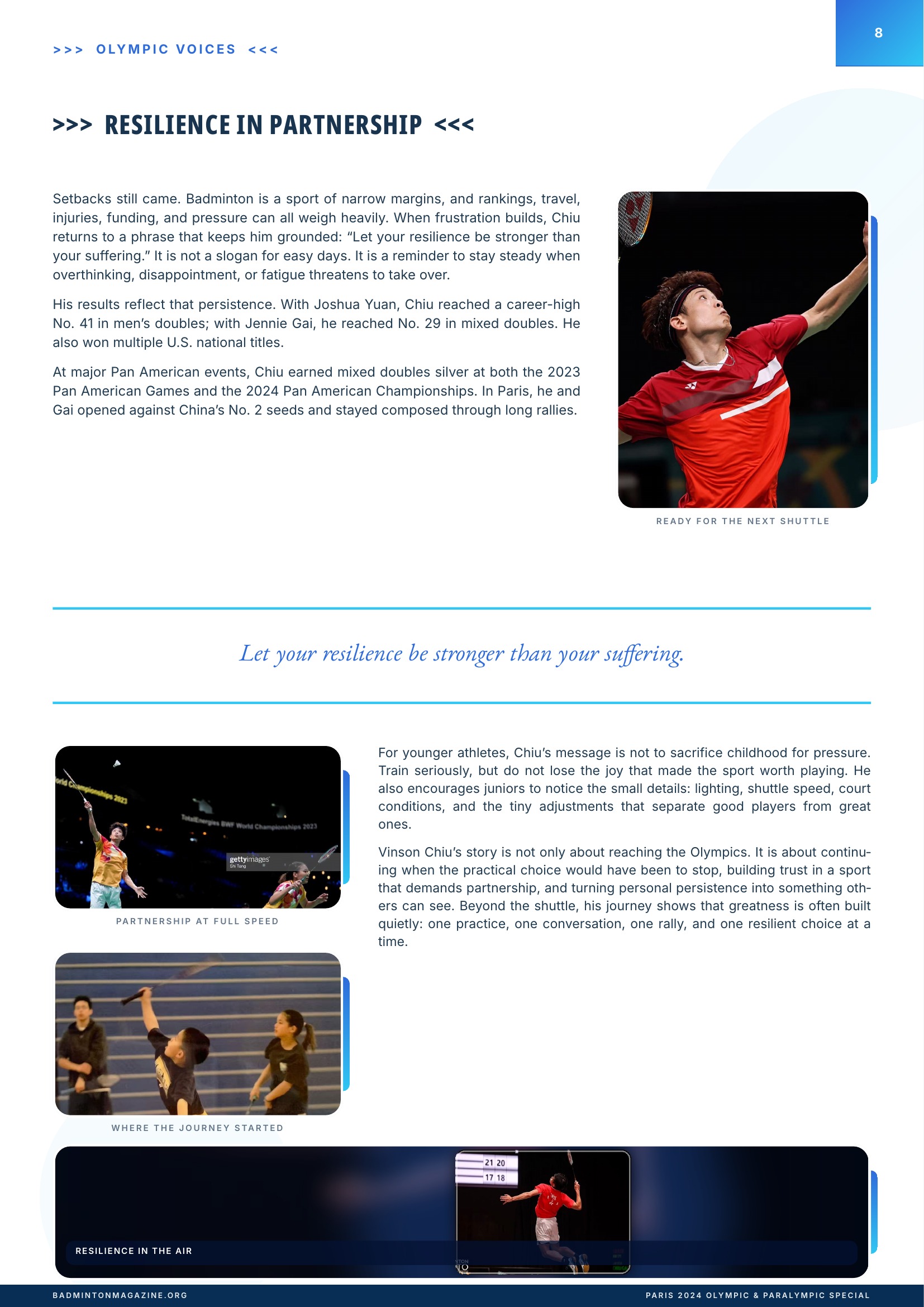
Setbacks still came. Badminton is a sport of narrow margins, and rankings, travel, injuries, funding, and pressure can all weigh heavily. When frustration builds, Chiu returns to a phrase that keeps him grounded: "Let your resilience be stronger than your suffering." It is not a slogan for easy days. It is a reminder to stay steady when overthinking, disappointment, or fatigue threatens to take over.
His results reflect that persistence. With Joshua Yuan, Chiu reached a career-high No. 41 in men's doubles; with Jennie Gai, he reached No. 29 in mixed doubles. He also won multiple U.S. national titles.
At major Pan American events, Chiu earned mixed doubles silver at both the 2023 Pan American Games and the 2024 Pan American Championships. In Paris, he and Gai opened against China's No. 2 seeds and stayed composed through long rallies.
Let your resilience be stronger than your suffering.
For younger athletes, Chiu's message is not to sacrifice childhood for pressure. Train seriously, but do not lose the joy that made the sport worth playing. He also encourages juniors to notice the small details: lighting, shuttle speed, court conditions, and the tiny adjustments that separate good players from great ones.
Vinson Chiu's story is not only about reaching the Olympics. It is about continuing when the practical choice would have been to stop, building trust in a sport that demands partnership, and turning personal persistence into something others can see. Beyond the shuttle, his journey shows that greatness is often built quietly: one practice, one conversation, one rally, and one resilient choice at a time.
Olympic Voices
The Olympian Mindset
Joshua Yuan's Path from Summer Camp to Paris 2024
By Elaina Xu
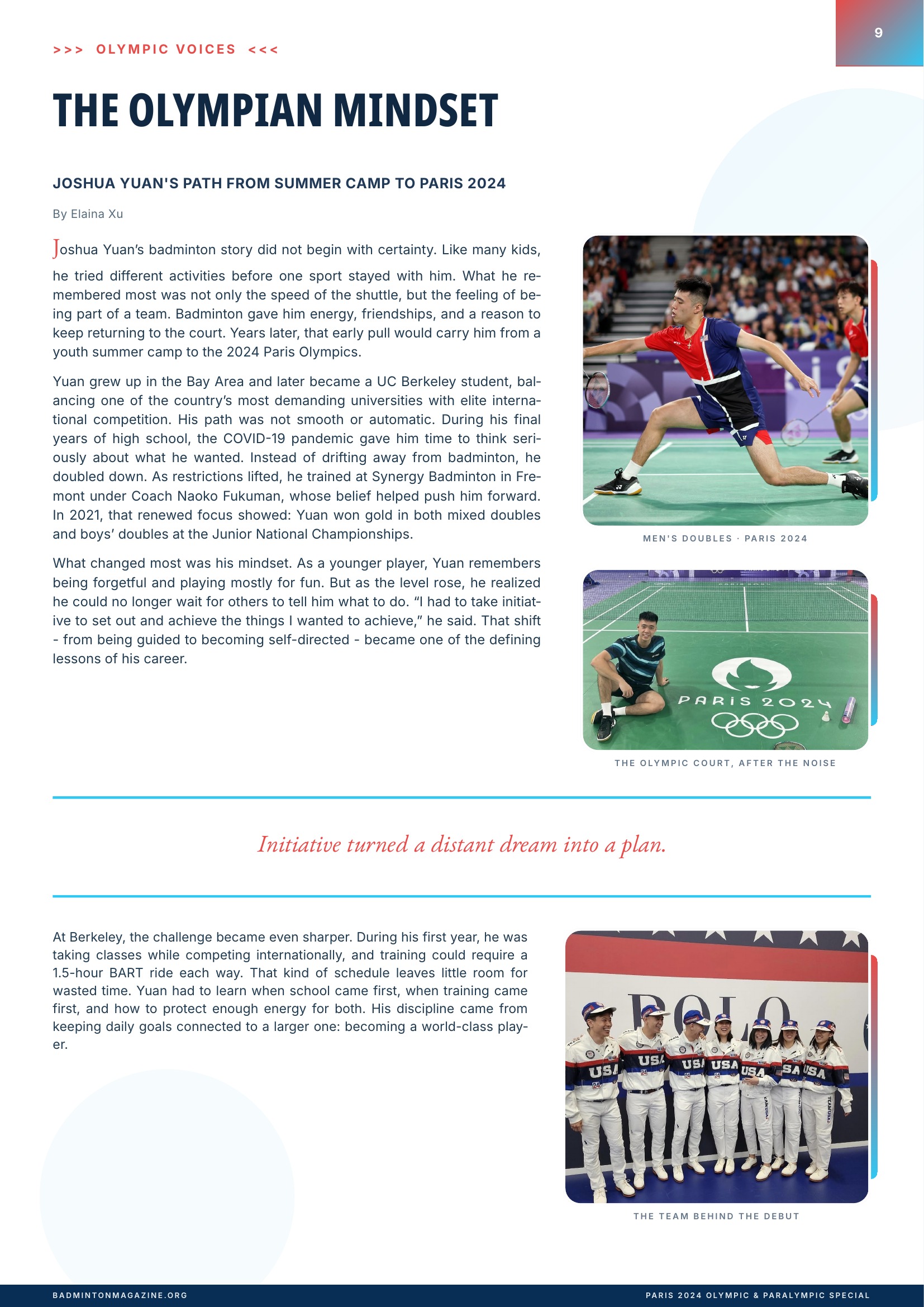
Joshua Yuan's badminton story did not begin with certainty. Like many kids, he tried different activities before one sport stayed with him. What he remembered most was not only the speed of the shuttle, but the feeling of being part of a team. Badminton gave him energy, friendships, and a reason to keep returning to the court. Years later, that early pull would carry him from a youth summer camp to the 2024 Paris Olympics.
Yuan grew up in the Bay Area and later became a UC Berkeley student, balancing one of the country's most demanding universities with elite international competition. His path was not smooth or automatic. During his final years of high school, the COVID-19 pandemic gave him time to think seriously about what he wanted. Instead of drifting away from badminton, he doubled down. As restrictions lifted, he trained at Synergy Badminton in Fremont under Coach Naoko Fukuman, whose belief helped push him forward. In 2021, that renewed focus showed: Yuan won gold in both mixed doubles and boys' doubles at the Junior National Championships.
What changed most was his mindset. As a younger player, Yuan remembers being forgetful and playing mostly for fun. But as the level rose, he realized he could no longer wait for others to tell him what to do. "I had to take initiative to set out and achieve the things I wanted to achieve," he said. That shift — from being guided to becoming self-directed — became one of the defining lessons of his career.
Initiative turned a distant dream into a plan.
At Berkeley, the challenge became even sharper. During his first year, he was taking classes while competing internationally, and training could require a 1.5-hour BART ride each way. That kind of schedule leaves little room for wasted time. Yuan had to learn when school came first, when training came first, and how to protect enough energy for both. His discipline came from keeping daily goals connected to a larger one: becoming a world-class player.
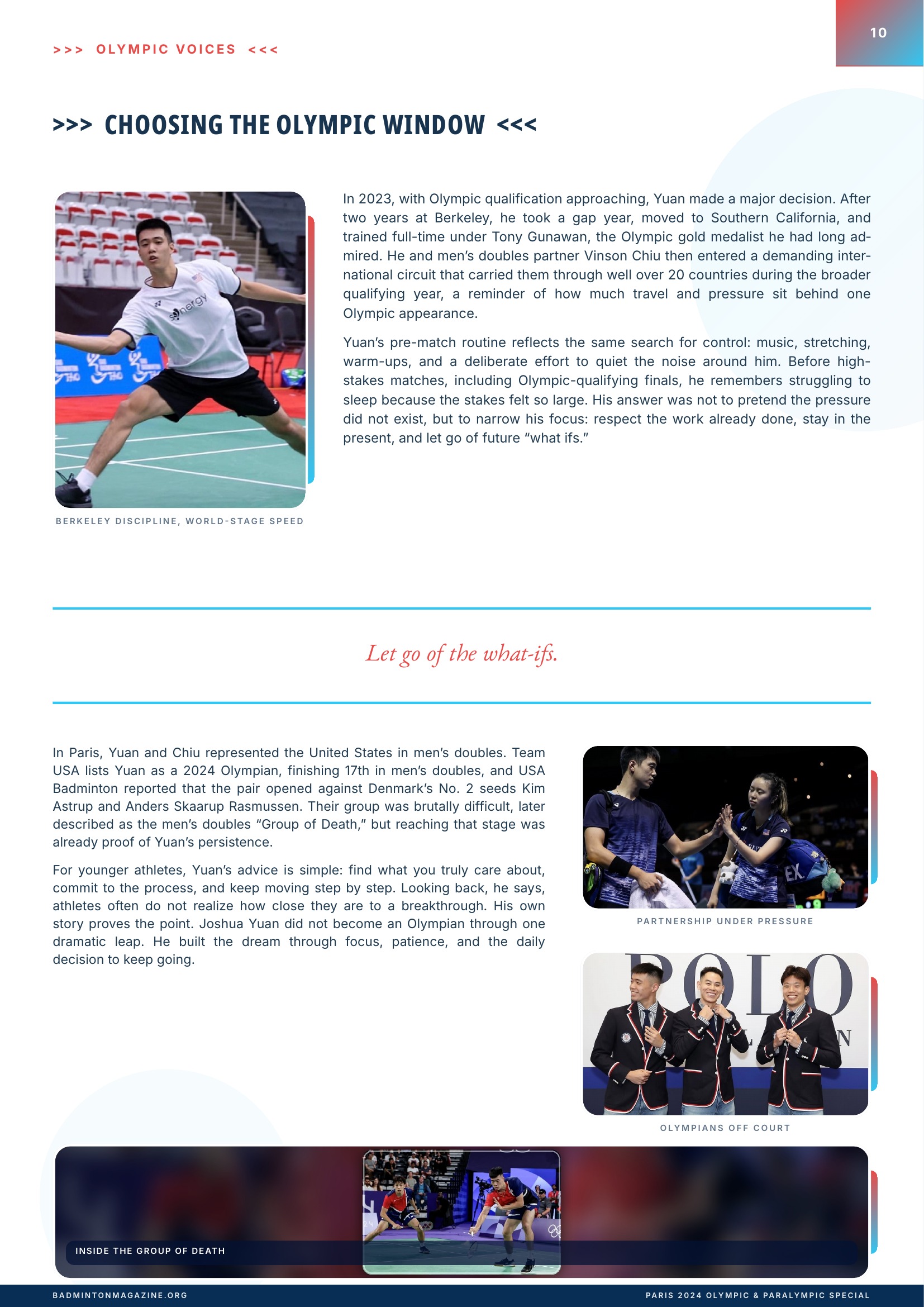
Choosing the Olympic Window
In 2023, with Olympic qualification approaching, Yuan made a major decision. After two years at Berkeley, he took a gap year, moved to Southern California, and trained full-time under Tony Gunawan, the Olympic gold medalist he had long admired. He and men's doubles partner Vinson Chiu then entered a demanding international circuit that carried them through well over 20 countries during the broader qualifying year, a reminder of how much travel and pressure sit behind one Olympic appearance.
Yuan's pre-match routine reflects the same search for control: music, stretching, warm-ups, and a deliberate effort to quiet the noise around him. Before high-stakes matches, including Olympic-qualifying finals, he remembers struggling to sleep because the stakes felt so large. His answer was not to pretend the pressure did not exist, but to narrow his focus: respect the work already done, stay in the present, and let go of future "what ifs."
Let go of the what-ifs.
In Paris, Yuan and Chiu represented the United States in men's doubles. Team USA lists Yuan as a 2024 Olympian, finishing 17th in men's doubles, and USA Badminton reported that the pair opened against Denmark's No. 2 seeds Kim Astrup and Anders Skaarup Rasmussen. Their group was brutally difficult, later described as the men's doubles "Group of Death," but reaching that stage was already proof of Yuan's persistence.
For younger athletes, Yuan's advice is simple: find what you truly care about, commit to the process, and keep moving step by step. Looking back, he says, athletes often do not realize how close they are to a breakthrough. His own story proves the point. Joshua Yuan did not become an Olympian through one dramatic leap. He built the dream through focus, patience, and the daily decision to keep going.
Paralympic History
The Road to Paralympic Glory
The Journeys of Jayci Simon and Miles Krajewski
By Manaskriti Sista
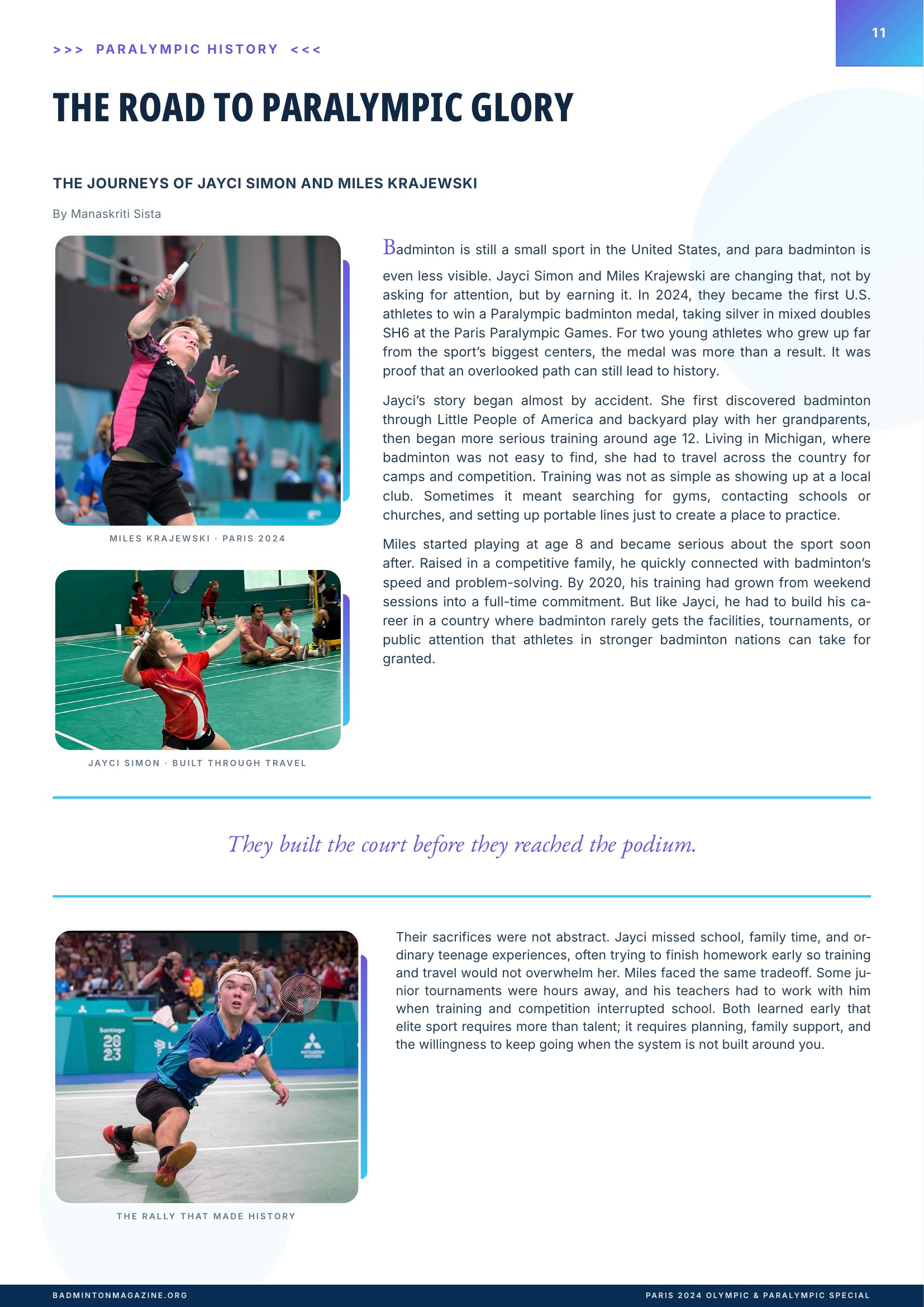
Badminton is still a small sport in the United States, and para badminton is even less visible. Jayci Simon and Miles Krajewski are changing that, not by asking for attention, but by earning it. In 2024, they became the first U.S. athletes to win a Paralympic badminton medal, taking silver in mixed doubles SH6 at the Paris Paralympic Games. For two young athletes who grew up far from the sport's biggest centers, the medal was more than a result. It was proof that an overlooked path can still lead to history.
Jayci's story began almost by accident. She first discovered badminton through Little People of America and backyard play with her grandparents, then began more serious training around age 12. Living in Michigan, where badminton was not easy to find, she had to travel across the country for camps and competition. Training was not as simple as showing up at a local club. Sometimes it meant searching for gyms, contacting schools or churches, and setting up portable lines just to create a place to practice.
Miles started playing at age 8 and became serious about the sport soon after. Raised in a competitive family, he quickly connected with badminton's speed and problem-solving. By 2020, his training had grown from weekend sessions into a full-time commitment. But like Jayci, he had to build his career in a country where badminton rarely gets the facilities, tournaments, or public attention that athletes in stronger badminton nations can take for granted.
They built the court before they reached the podium.
Their sacrifices were not abstract. Jayci missed school, family time, and ordinary teenage experiences, often trying to finish homework early so training and travel would not overwhelm her. Miles faced the same tradeoff. Some junior tournaments were hours away, and his teachers had to work with him when training and competition interrupted school. Both learned early that elite sport requires more than talent; it requires planning, family support, and the willingness to keep going when the system is not built around you.
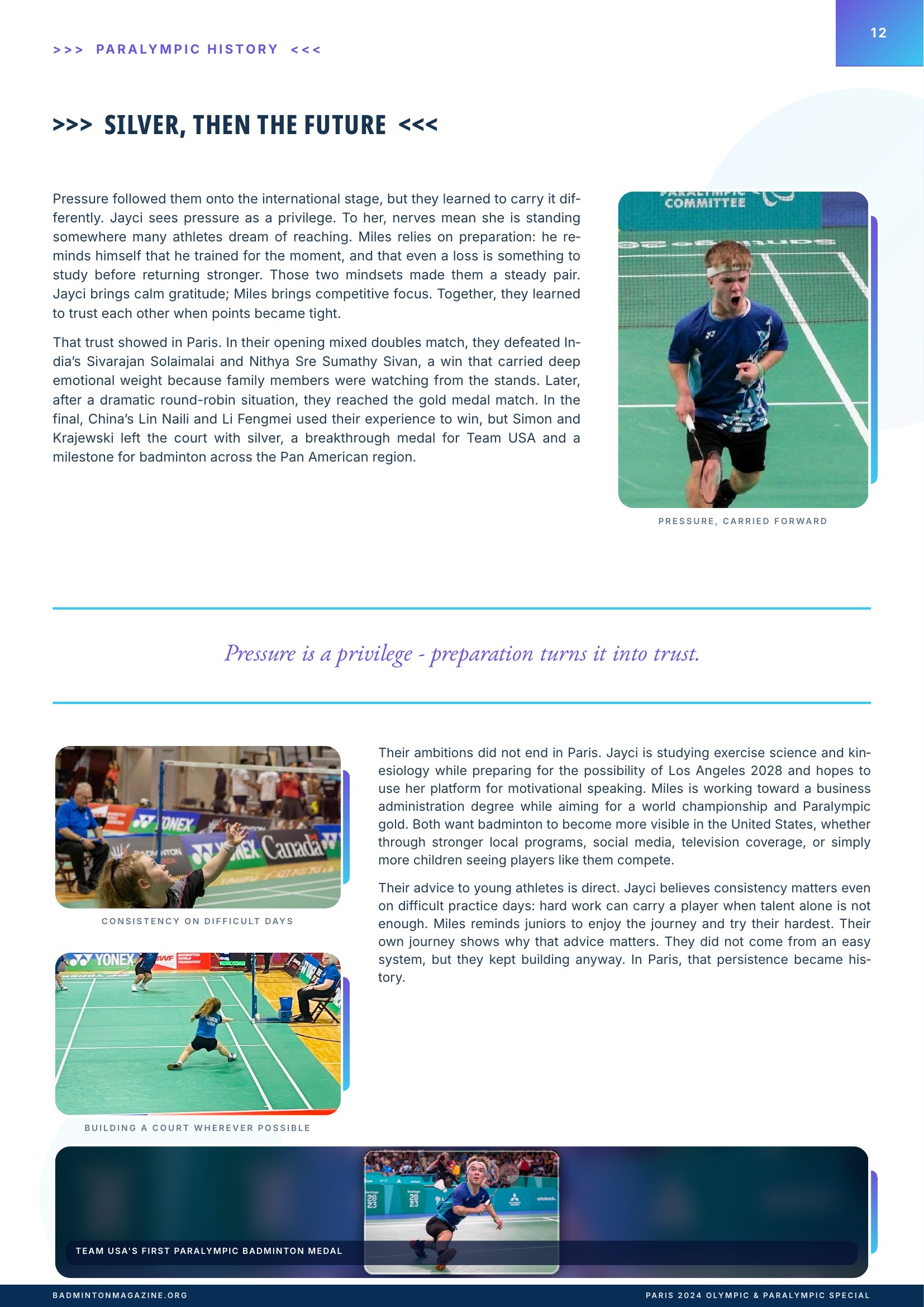
Silver, Then the Future
Pressure followed them onto the international stage, but they learned to carry it differently. Jayci sees pressure as a privilege. To her, nerves mean she is standing somewhere many athletes dream of reaching. Miles relies on preparation: he reminds himself that he trained for the moment, and that even a loss is something to study before returning stronger. Those two mindsets made them a steady pair. Jayci brings calm gratitude; Miles brings competitive focus. Together, they learned to trust each other when points became tight.
That trust showed in Paris. In their opening mixed doubles match, they defeated India's Sivarajan Solaimalai and Nithya Sre Sumathy Sivan, a win that carried deep emotional weight because family members were watching from the stands. Later, after a dramatic round-robin situation, they reached the gold medal match. In the final, China's Lin Naili and Li Fengmei used their experience to win, but Simon and Krajewski left the court with silver, a breakthrough medal for Team USA and a milestone for badminton across the Pan American region.
Pressure is a privilege — preparation turns it into trust.
Their ambitions did not end in Paris. Jayci is studying exercise science and kinesiology while preparing for the possibility of Los Angeles 2028 and hopes to use her platform for motivational speaking. Miles is working toward a business administration degree while aiming for a world championship and Paralympic gold. Both want badminton to become more visible in the United States, whether through stronger local programs, social media, television coverage, or simply more children seeing players like them compete.
Their advice to young athletes is direct. Jayci believes consistency matters even on difficult practice days: hard work can carry a player when talent alone is not enough. Miles reminds juniors to enjoy the journey and try their hardest. Their own journey shows why that advice matters. They did not come from an easy system, but they kept building anyway. In Paris, that persistence became history.
Builders of the Game
The Story of Abhishek Ahlawat
Building Access, Mentorship, and the Future of American Badminton
By Camellia Wang
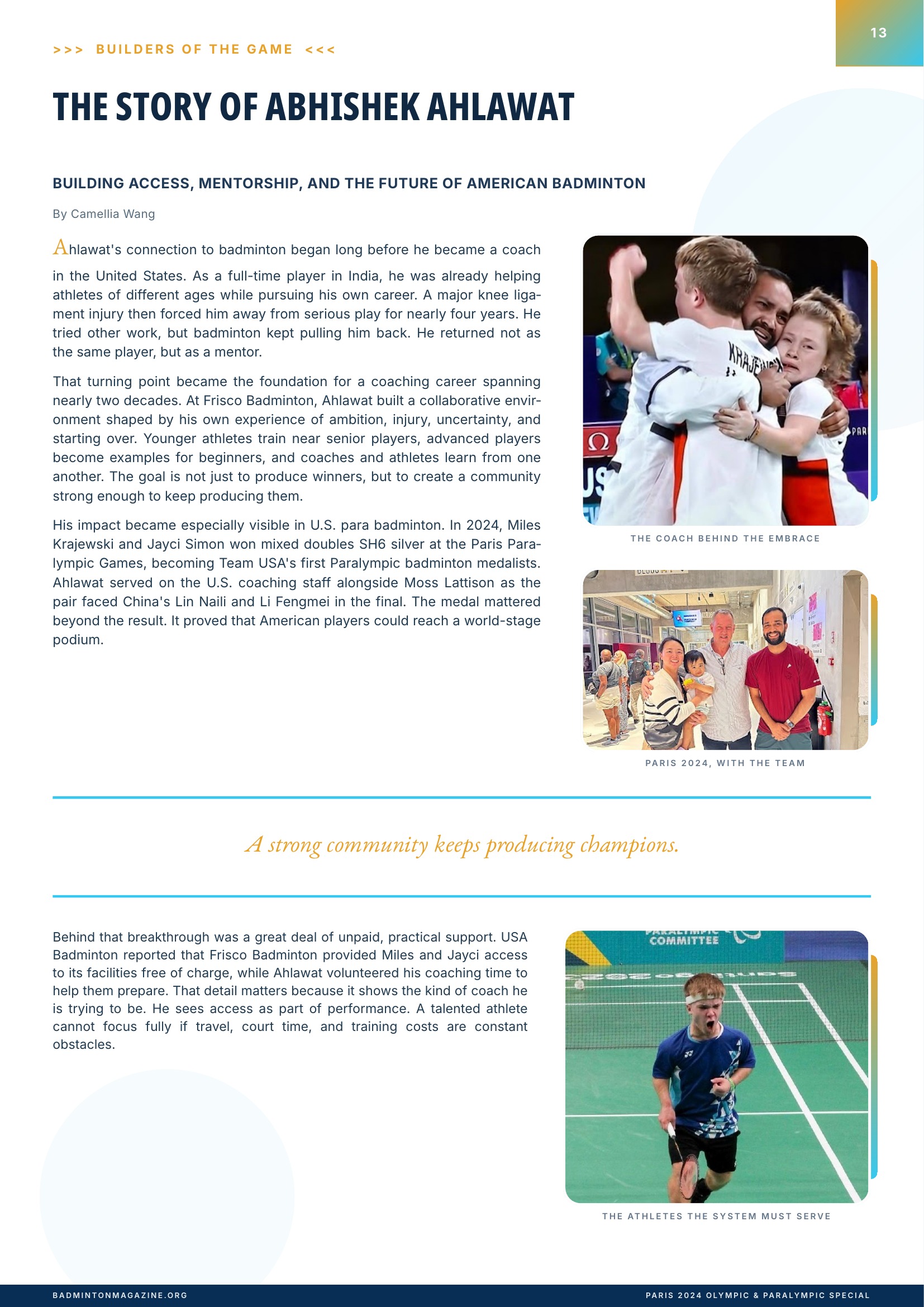
Ahlawat's connection to badminton began long before he became a coach in the United States. As a full-time player in India, he was already helping athletes of different ages while pursuing his own career. A major knee ligament injury then forced him away from serious play for nearly four years. He tried other work, but badminton kept pulling him back. He returned not as the same player, but as a mentor.
That turning point became the foundation for a coaching career spanning nearly two decades. At Frisco Badminton, Ahlawat built a collaborative environment shaped by his own experience of ambition, injury, uncertainty, and starting over. Younger athletes train near senior players, advanced players become examples for beginners, and coaches and athletes learn from one another. The goal is not just to produce winners, but to create a community strong enough to keep producing them.
His impact became especially visible in U.S. para badminton. In 2024, Miles Krajewski and Jayci Simon won mixed doubles SH6 silver at the Paris Paralympic Games, becoming Team USA's first Paralympic badminton medalists. Ahlawat served on the U.S. coaching staff alongside Moss Lattison as the pair faced China's Lin Naili and Li Fengmei in the final. The medal mattered beyond the result. It proved that American players could reach a world-stage podium.
A strong community keeps producing champions.
Behind that breakthrough was a great deal of unpaid, practical support. USA Badminton reported that Frisco Badminton provided Miles and Jayci access to its facilities free of charge, while Ahlawat volunteered his coaching time to help them prepare. That detail matters because it shows the kind of coach he is trying to be. He sees access as part of performance. A talented athlete cannot focus fully if travel, court time, and training costs are constant obstacles.
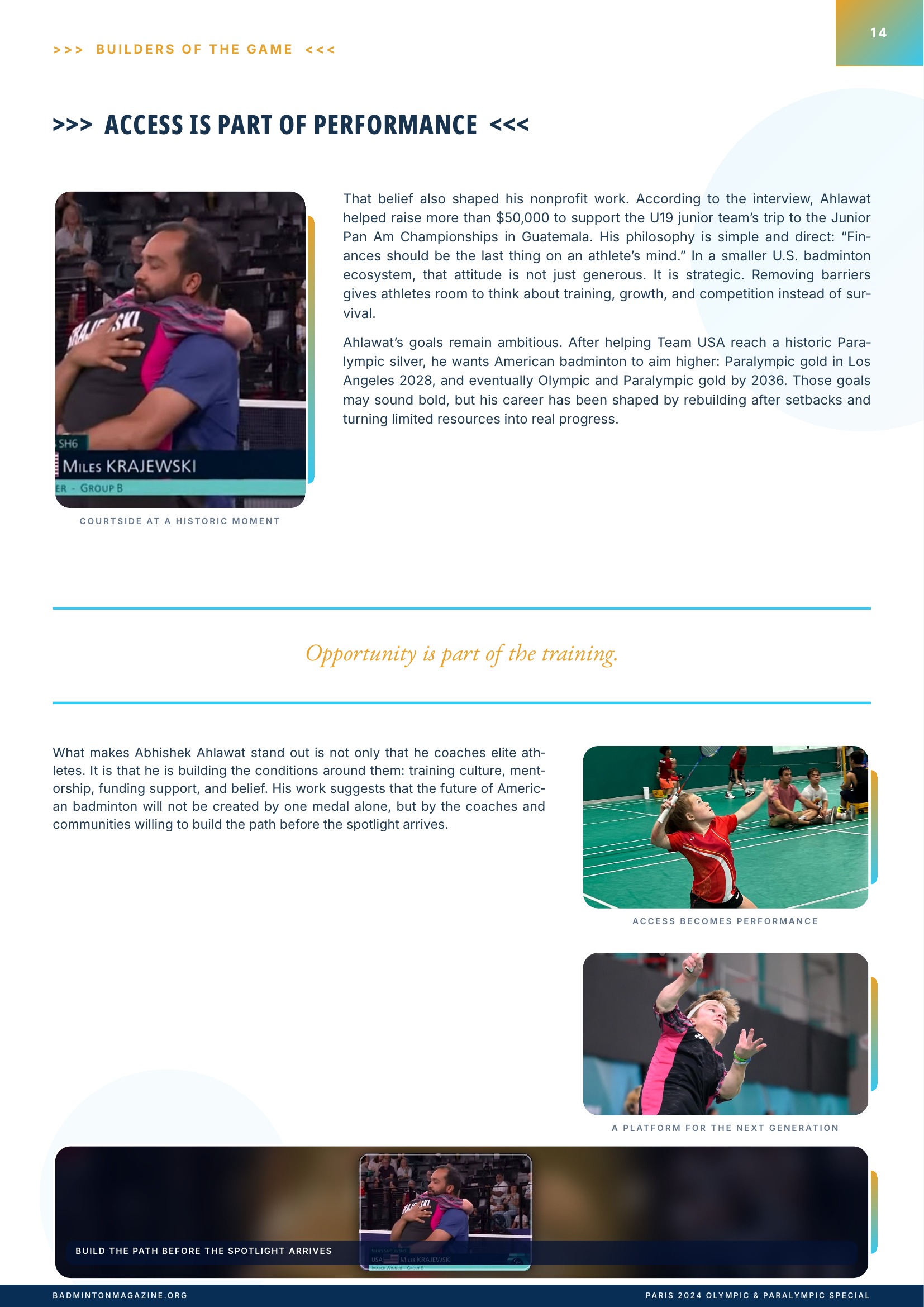
Access Is Part of Performance
That belief also shaped his nonprofit work. According to the interview, Ahlawat helped raise more than $50,000 to support the U19 junior team's trip to the Junior Pan Am Championships in Guatemala. His philosophy is simple and direct: "Finances should be the last thing on an athlete's mind." In a smaller U.S. badminton ecosystem, that attitude is not just generous. It is strategic. Removing barriers gives athletes room to think about training, growth, and competition instead of survival.
Ahlawat's goals remain ambitious. After helping Team USA reach a historic Paralympic silver, he wants American badminton to aim higher: Paralympic gold in Los Angeles 2028, and eventually Olympic and Paralympic gold by 2036. Those goals may sound bold, but his career has been shaped by rebuilding after setbacks and turning limited resources into real progress.
Opportunity is part of the training.
What makes Abhishek Ahlawat stand out is not only that he coaches elite athletes. It is that he is building the conditions around them: training culture, mentorship, funding support, and belief. His work suggests that the future of American badminton will not be created by one medal alone, but by the coaches and communities willing to build the path before the spotlight arrives.
Pan-American Icon
Beyond Rankings, Beyond Doubt
Michelle Li on Commitment, Time, and the Future of North American Badminton
By Oliver Chen
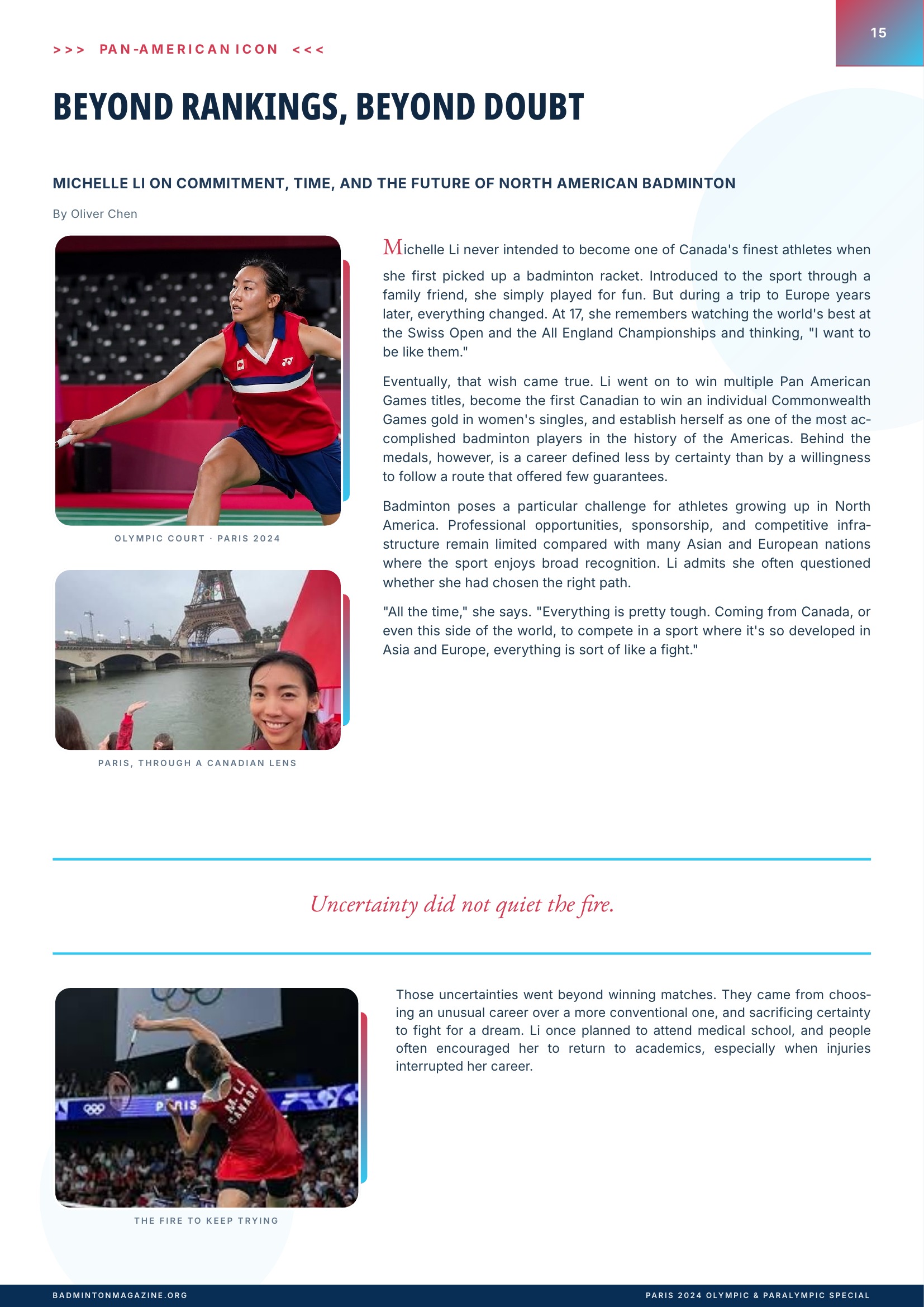
Michelle Li never intended to become one of Canada's finest athletes when she first picked up a badminton racket. Introduced to the sport through a family friend, she simply played for fun. But during a trip to Europe years later, everything changed. At 17, she remembers watching the world's best at the Swiss Open and the All England Championships and thinking, "I want to be like them."
Eventually, that wish came true. Li went on to win multiple Pan American Games titles, become the first Canadian to win an individual Commonwealth Games gold in women's singles, and establish herself as one of the most accomplished badminton players in the history of the Americas. Behind the medals, however, is a career defined less by certainty than by a willingness to follow a route that offered few guarantees.
Badminton poses a particular challenge for athletes growing up in North America. Professional opportunities, sponsorship, and competitive infrastructure remain limited compared with many Asian and European nations where the sport enjoys broad recognition. Li admits she often questioned whether she had chosen the right path.
"All the time," she says. "Everything is pretty tough. Coming from Canada, or even this side of the world, to compete in a sport where it's so developed in Asia and Europe, everything is sort of like a fight."
Uncertainty did not quiet the fire.
Those uncertainties went beyond winning matches. They came from choosing an unusual career over a more conventional one, and sacrificing certainty to fight for a dream. Li once planned to attend medical school, and people often encouraged her to return to academics, especially when injuries interrupted her career.
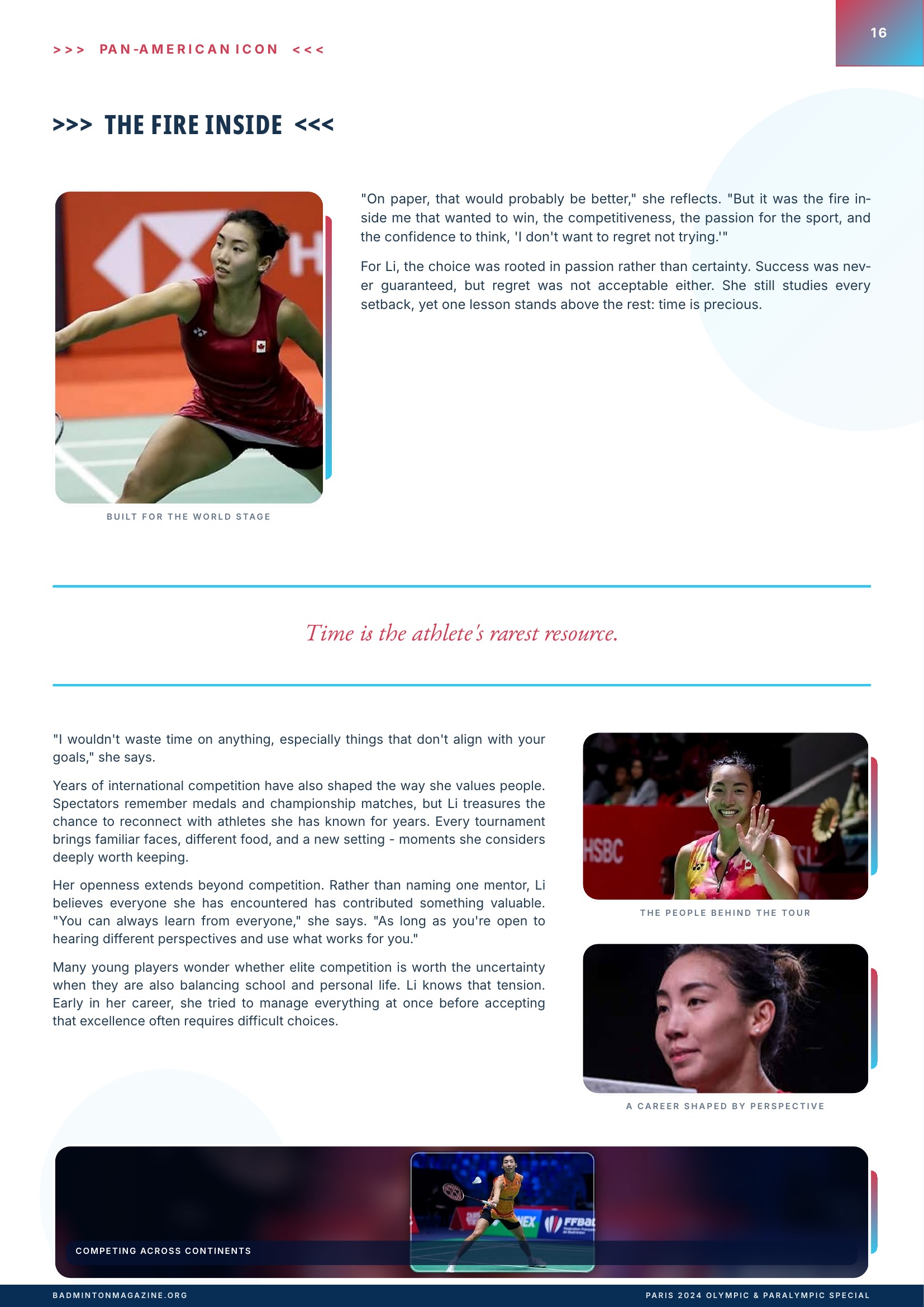
The Fire Inside
"On paper, that would probably be better," she reflects. "But it was the fire inside me that wanted to win, the competitiveness, the passion for the sport, and the confidence to think, 'I don't want to regret not trying.'"
For Li, the choice was rooted in passion rather than certainty. Success was never guaranteed, but regret was not acceptable either. She still studies every setback, yet one lesson stands above the rest: time is precious.
Time is the athlete's rarest resource.
"I wouldn't waste time on anything, especially things that don't align with your goals," she says.
Years of international competition have also shaped the way she values people. Spectators remember medals and championship matches, but Li treasures the chance to reconnect with athletes she has known for years. Every tournament brings familiar faces, different food, and a new setting — moments she considers deeply worth keeping.
Her openness extends beyond competition. Rather than naming one mentor, Li believes everyone she has encountered has contributed something valuable. "You can always learn from everyone," she says. "As long as you're open to hearing different perspectives and use what works for you."
Many young players wonder whether elite competition is worth the uncertainty when they are also balancing school and personal life. Li knows that tension. Early in her career, she tried to manage everything at once before accepting that excellence often requires difficult choices.
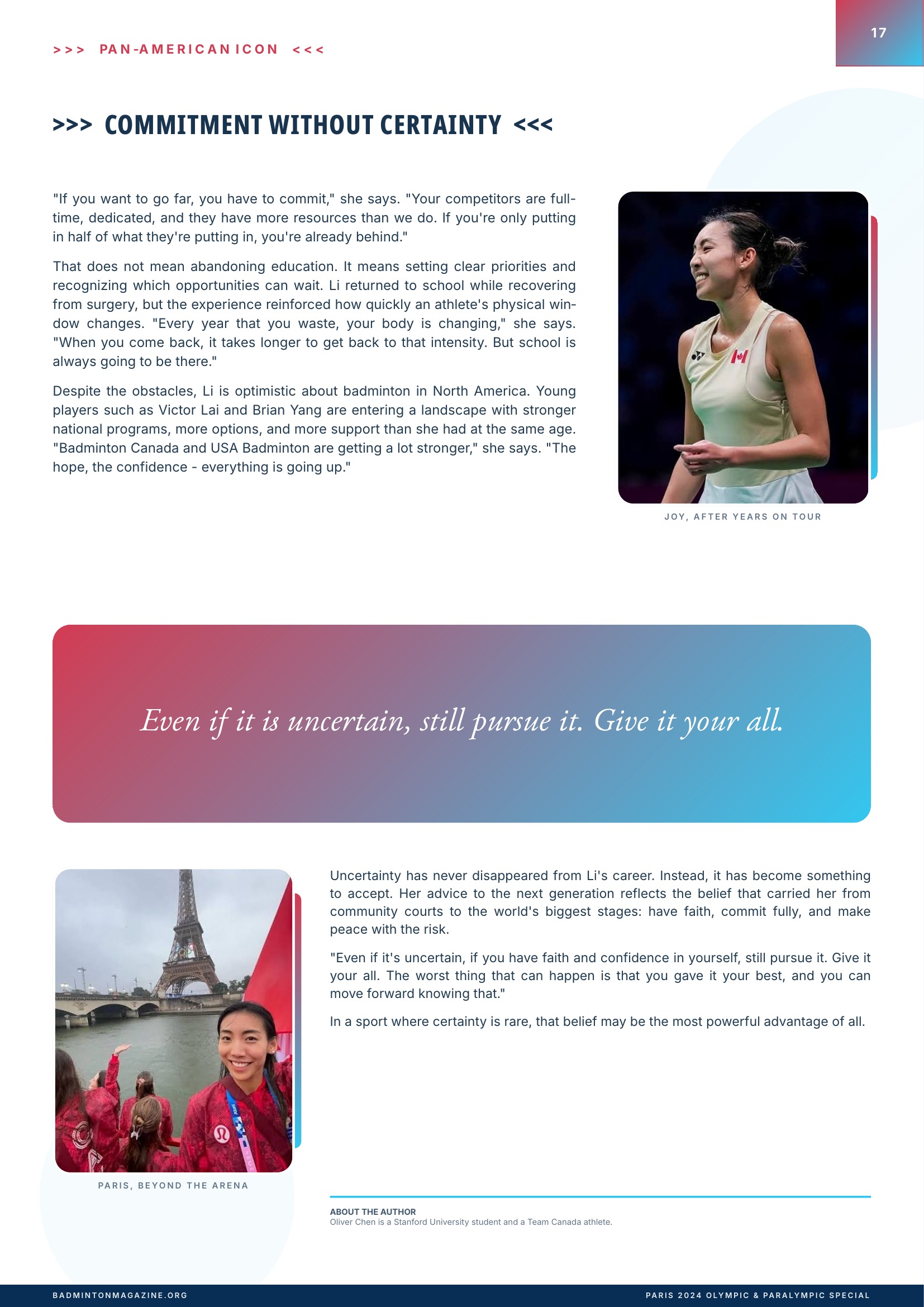
Commitment Without Certainty
"If you want to go far, you have to commit," she says. "Your competitors are full-time, dedicated, and they have more resources than we do. If you're only putting in half of what they're putting in, you're already behind."
That does not mean abandoning education. It means setting clear priorities and recognizing which opportunities can wait. Li returned to school while recovering from surgery, but the experience reinforced how quickly an athlete's physical window changes. "Every year that you waste, your body is changing," she says. "When you come back, it takes longer to get back to that intensity. But school is always going to be there."
Despite the obstacles, Li is optimistic about badminton in North America. Young players such as Victor Lai and Brian Yang are entering a landscape with stronger national programs, more options, and more support than she had at the same age. "Badminton Canada and USA Badminton are getting a lot stronger," she says. "The hope, the confidence — everything is going up."
❯❯❯ Inspirational ❮❮❮
Even if it is uncertain, still pursue it. Give it your all.
Uncertainty has never disappeared from Li's career. Instead, it has become something to accept. Her advice to the next generation reflects the belief that carried her from community courts to the world's biggest stages: have faith, commit fully, and make peace with the risk.
"Even if it's uncertain, if you have faith and confidence in yourself, still pursue it. Give it your all. The worst thing that can happen is that you gave it your best, and you can move forward knowing that."
In a sport where certainty is rare, that belief may be the most powerful advantage of all.
About the Author
Oliver Chen is a Stanford University student and a Team Canada athlete.
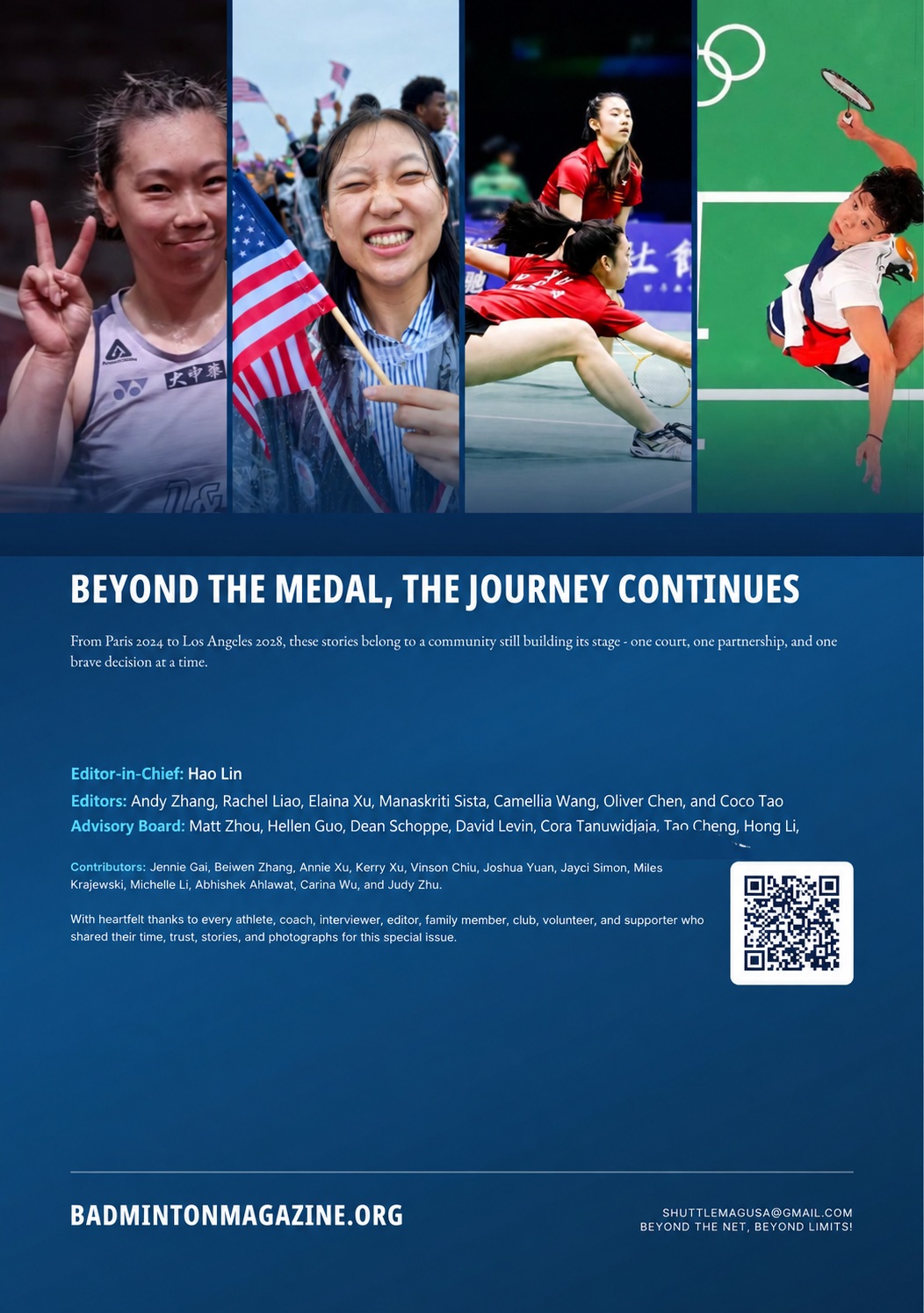
Beyond the Medal, the Journey Continues
From Paris 2024 to Los Angeles 2028, these stories belong to a community still building its stage — one court, one partnership, and one brave decision at a time.
Masthead
- Editor-in-Chief: Hao Lin
- Editors: Andy Zhang, Rachel Liao, Elaina Xu, Manaskriti Sista, Camellia Wang, Oliver Chen, and Coco Tao
- Advisory Board: Matt Zhou, Hellen Guo, Dean Schoppe, David Levin, Cora Tanuwidjaja, Tao Cheng, Hong Li
- Contributors: Jennie Gai, Beiwen Zhang, Annie Xu, Kerry Xu, Vinson Chiu, Joshua Yuan, Jayci Simon, Miles Krajewski, Michelle Li, Abhishek Ahlawat, Carina Wu, and Judy Zhu
With heartfelt thanks to every athlete, coach, interviewer, editor, family member, club, volunteer, and supporter who shared their time, trust, stories, and photographs for this special issue.