Featured Coach
Hendry Winarto
The Calm Behind Team USA's Junior Rise
By Tao Cheng
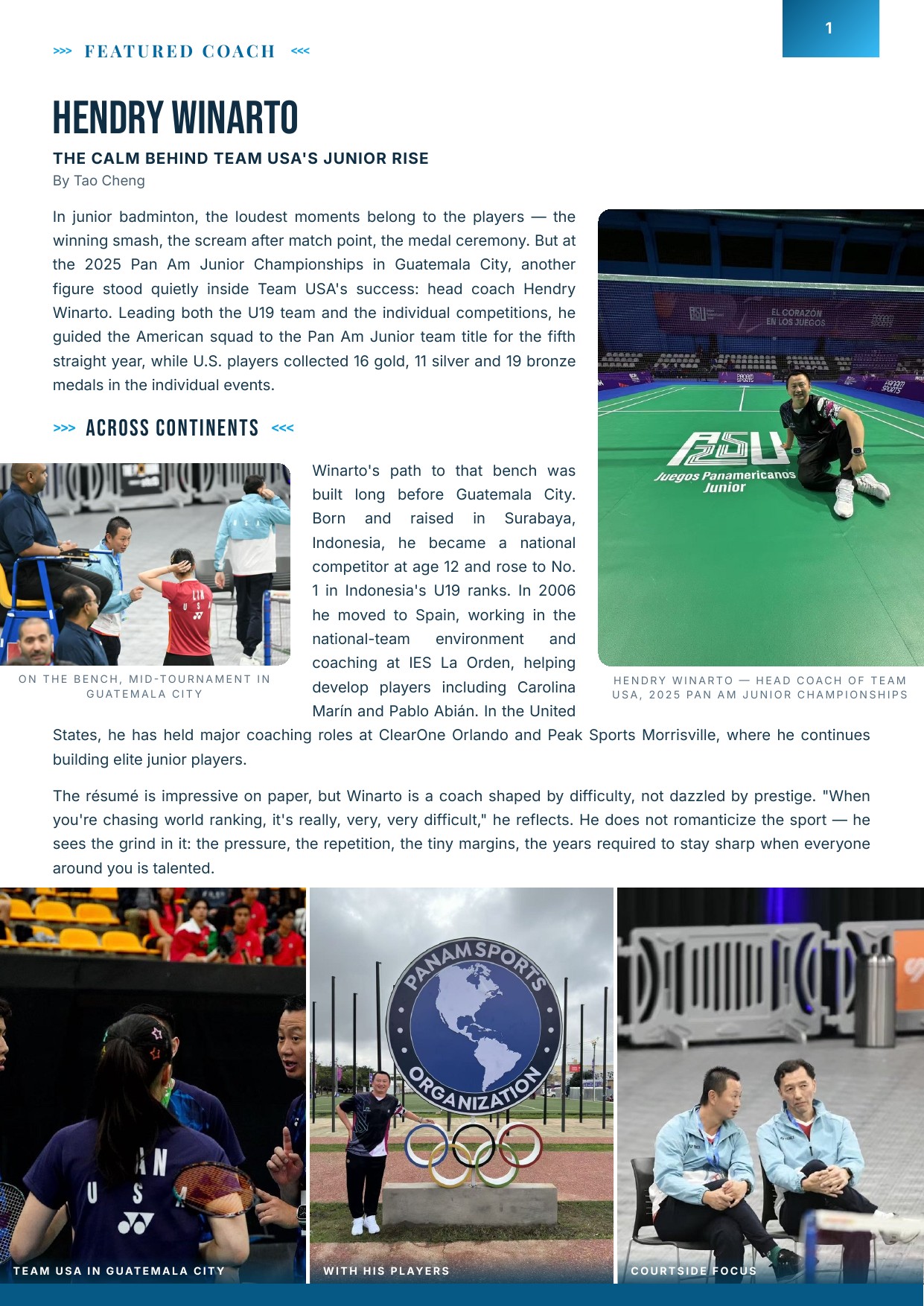
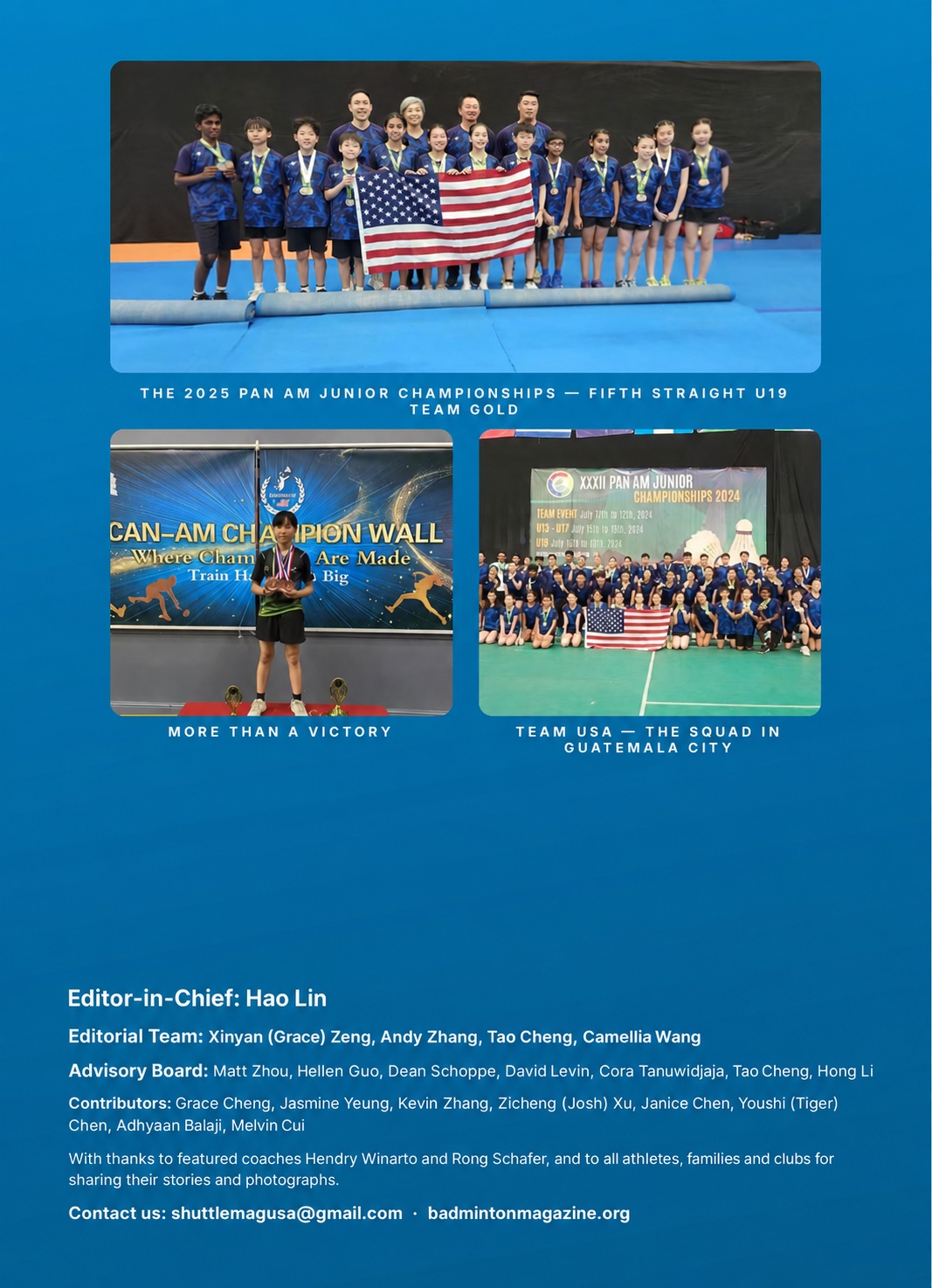
In junior badminton, the loudest moments belong to the players — the winning smash, the scream after match point, the medal ceremony. But at the 2025 Pan Am Junior Championships in Guatemala City, another figure stood quietly inside Team USA's success: head coach Hendry Winarto. Leading both the U19 team and the individual competitions, he guided the American squad to the Pan Am Junior team title for the fifth straight year, while U.S. players collected 16 gold, 11 silver and 19 bronze medals in the individual events.
Across Continents
Winarto's path to that bench was built long before Guatemala City. Born and raised in Surabaya, Indonesia, he became a national competitor at age 12 and rose to No. 1 in Indonesia's U19 ranks. In 2006 he moved to Spain, working in the national-team environment and coaching at IES La Orden, helping develop players including Carolina Marín and Pablo Abián. In the United States, he has held major coaching roles at ClearOne Orlando and Peak Sports Morrisville, where he continues building elite junior players.
The résumé is impressive on paper, but Winarto is a coach shaped by difficulty, not dazzled by prestige. "When you're chasing world ranking, it's really, very, very difficult," he reflects. He does not romanticize the sport — he sees the grind in it: the pressure, the repetition, the tiny margins, the years required to stay sharp when everyone around you is talented.
Confidence Is the Structure
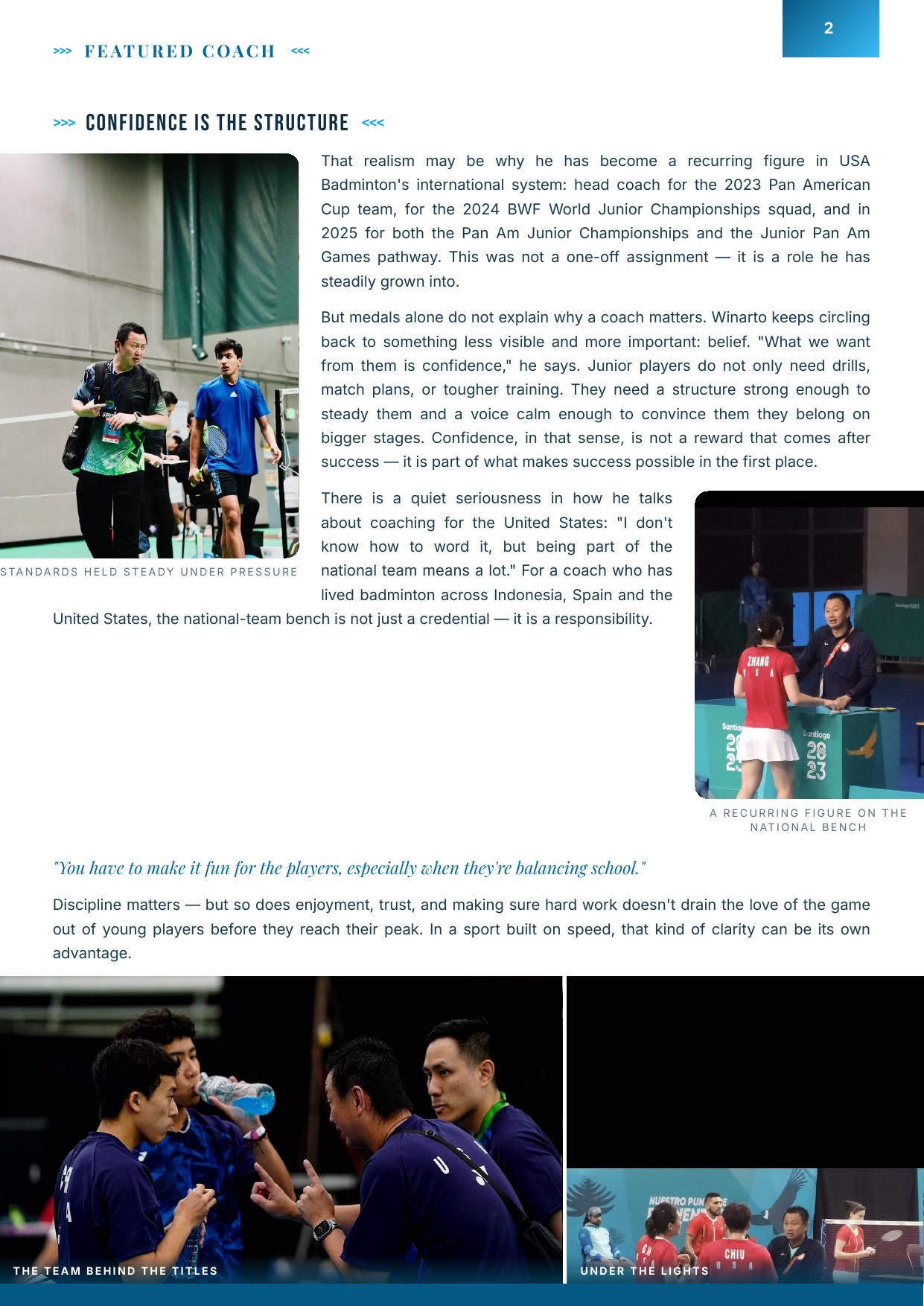
That realism may be why he has become a recurring figure in USA Badminton's international system: head coach for the 2023 Pan American Cup team, for the 2024 BWF World Junior Championships squad, and in 2025 for both the Pan Am Junior Championships and the Junior Pan Am Games pathway. This was not a one-off assignment — it is a role he has steadily grown into.
But medals alone do not explain why a coach matters. Winarto keeps circling back to something less visible and more important: belief. "What we want from them is confidence," he says. Junior players do not only need drills, match plans, or tougher training. They need a structure strong enough to steady them and a voice calm enough to convince them they belong on bigger stages. Confidence, in that sense, is not a reward that comes after success — it is part of what makes success possible in the first place.
There is a quiet seriousness in how he talks about coaching for the United States: "I don't know how to word it, but being part of the national team means a lot." For a coach who has lived badminton across Indonesia, Spain and the United States, the national-team bench is not just a credential — it is a responsibility.
"You have to make it fun for the players, especially when they're balancing school."
Discipline matters — but so does enjoyment, trust, and making sure hard work doesn't drain the love of the game out of young players before they reach their peak. In a sport built on speed, that kind of clarity can be its own advantage.
Featured Coach
Rong Schafer
The Quiet Precision Behind Team USA's Junior Standard
By Tao Cheng
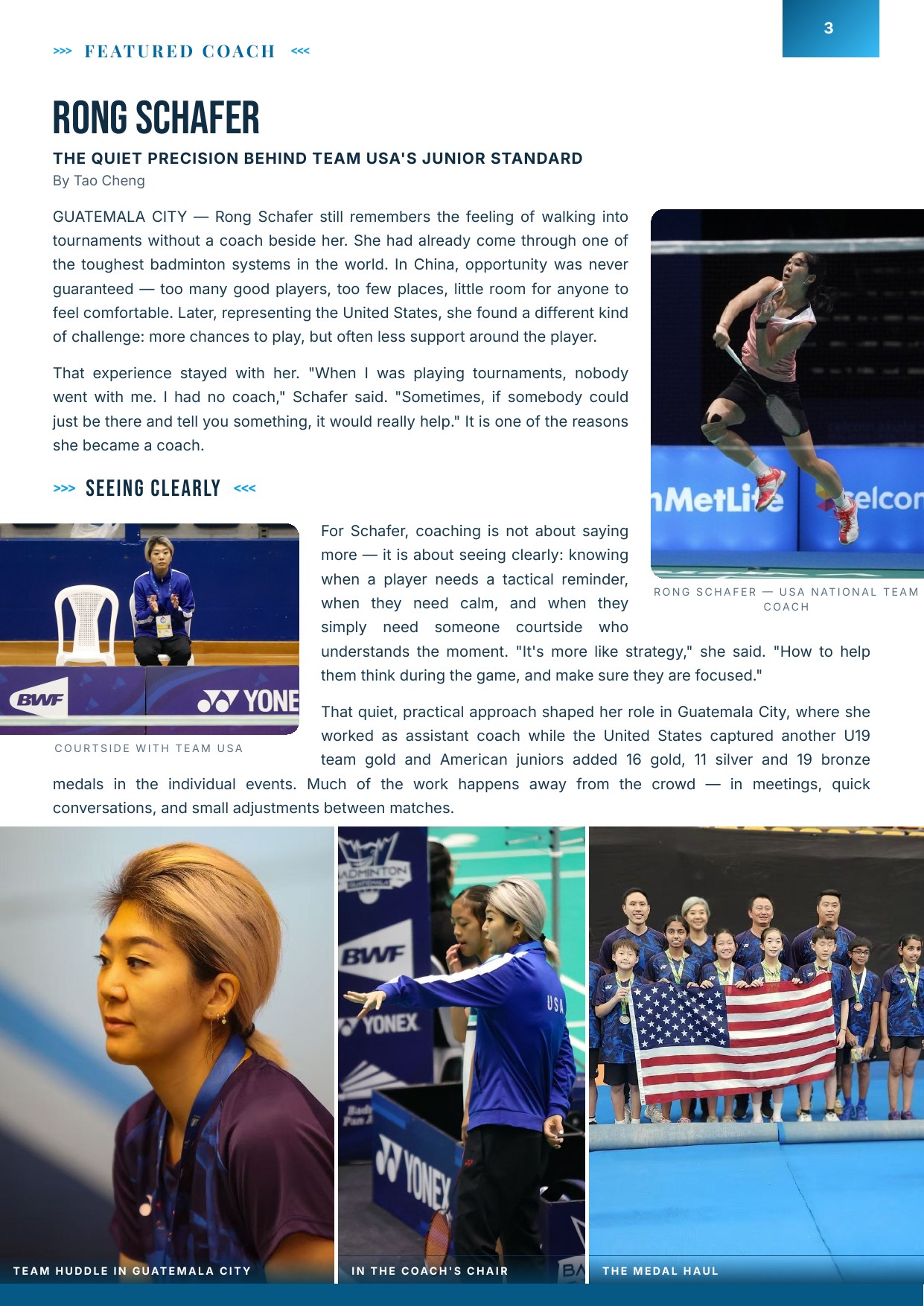
GUATEMALA CITY — Rong Schafer still remembers the feeling of walking into tournaments without a coach beside her. She had already come through one of the toughest badminton systems in the world. In China, opportunity was never guaranteed — too many good players, too few places, little room for anyone to feel comfortable. Later, representing the United States, she found a different kind of challenge: more chances to play, but often less support around the player.
That experience stayed with her. "When I was playing tournaments, nobody went with me. I had no coach," Schafer said. "Sometimes, if somebody could just be there and tell you something, it would really help." It is one of the reasons she became a coach.
Seeing Clearly
For Schafer, coaching is not about saying more — it is about seeing clearly: knowing when a player needs a tactical reminder, when they need calm, and when they simply need someone courtside who understands the moment. "It's more like strategy," she said. "How to help them think during the game, and make sure they are focused."
That quiet, practical approach shaped her role in Guatemala City, where she worked as assistant coach while the United States captured another U19 team gold and American juniors added 16 gold, 11 silver and 19 bronze medals in the individual events. Much of the work happens away from the crowd — in meetings, quick conversations, and small adjustments between matches.
"Keep Playing Longer"
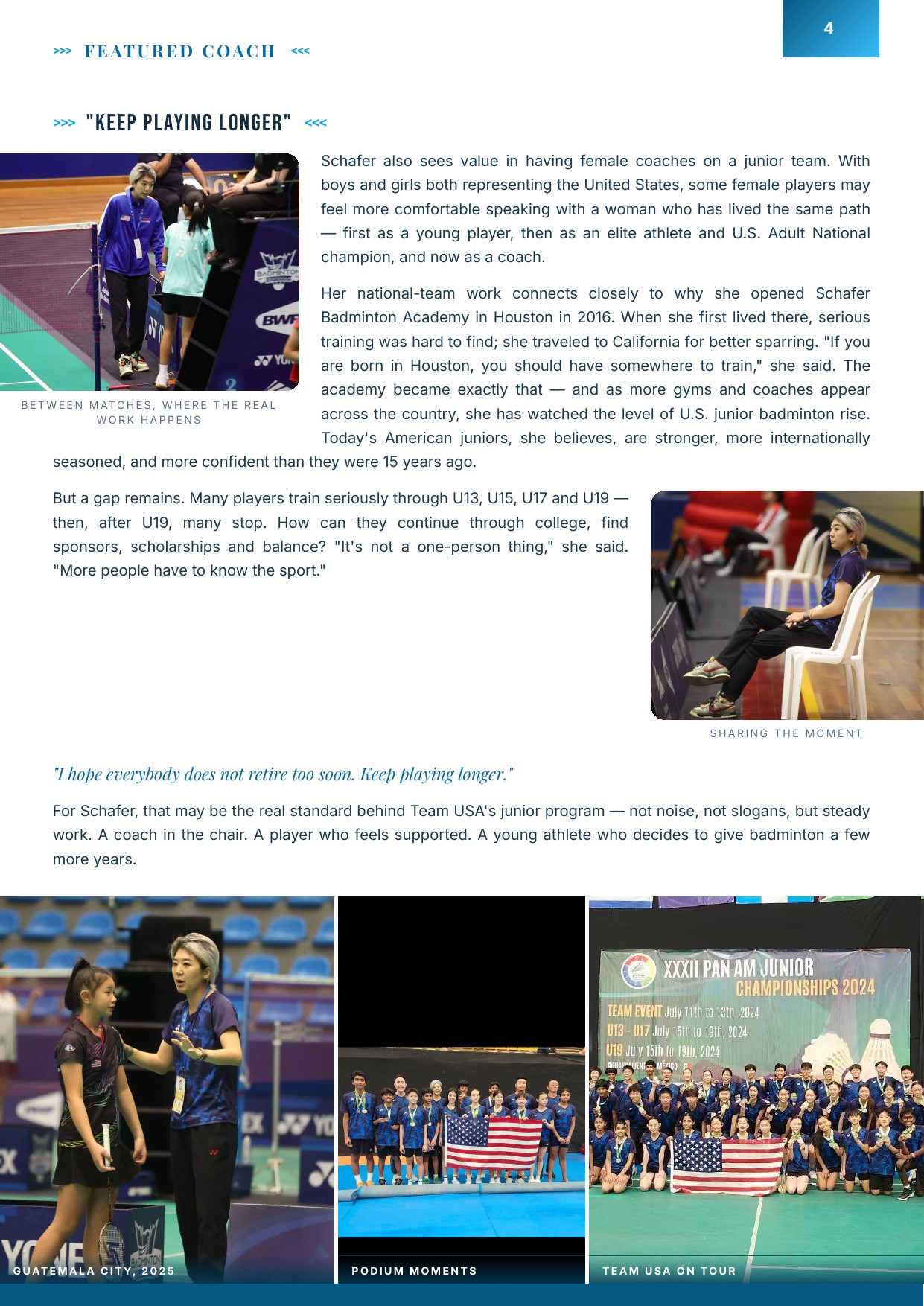
Schafer also sees value in having female coaches on a junior team. With boys and girls both representing the United States, some female players may feel more comfortable speaking with a woman who has lived the same path — first as a young player, then as an elite athlete and U.S. Adult National champion, and now as a coach.
Her national-team work connects closely to why she opened Schafer Badminton Academy in Houston in 2016. When she first lived there, serious training was hard to find; she traveled to California for better sparring. "If you are born in Houston, you should have somewhere to train," she said. The academy became exactly that — and as more gyms and coaches appear across the country, she has watched the level of U.S. junior badminton rise. Today's American juniors, she believes, are stronger, more internationally seasoned, and more confident than they were 15 years ago.
But a gap remains. Many players train seriously through U13, U15, U17 and U19 — then, after U19, many stop. How can they continue through college, find sponsors, scholarships and balance? "It's not a one-person thing," she said. "More people have to know the sport."
"I hope everybody does not retire too soon. Keep playing longer."
For Schafer, that may be the real standard behind Team USA's junior program — not noise, not slogans, but steady work. A coach in the chair. A player who feels supported. A young athlete who decides to give badminton a few more years.
Inspirational Journey
More Than a Victory
One Match, One Ticket to Team USA — and a Lesson About Friendship
By Grace Cheng
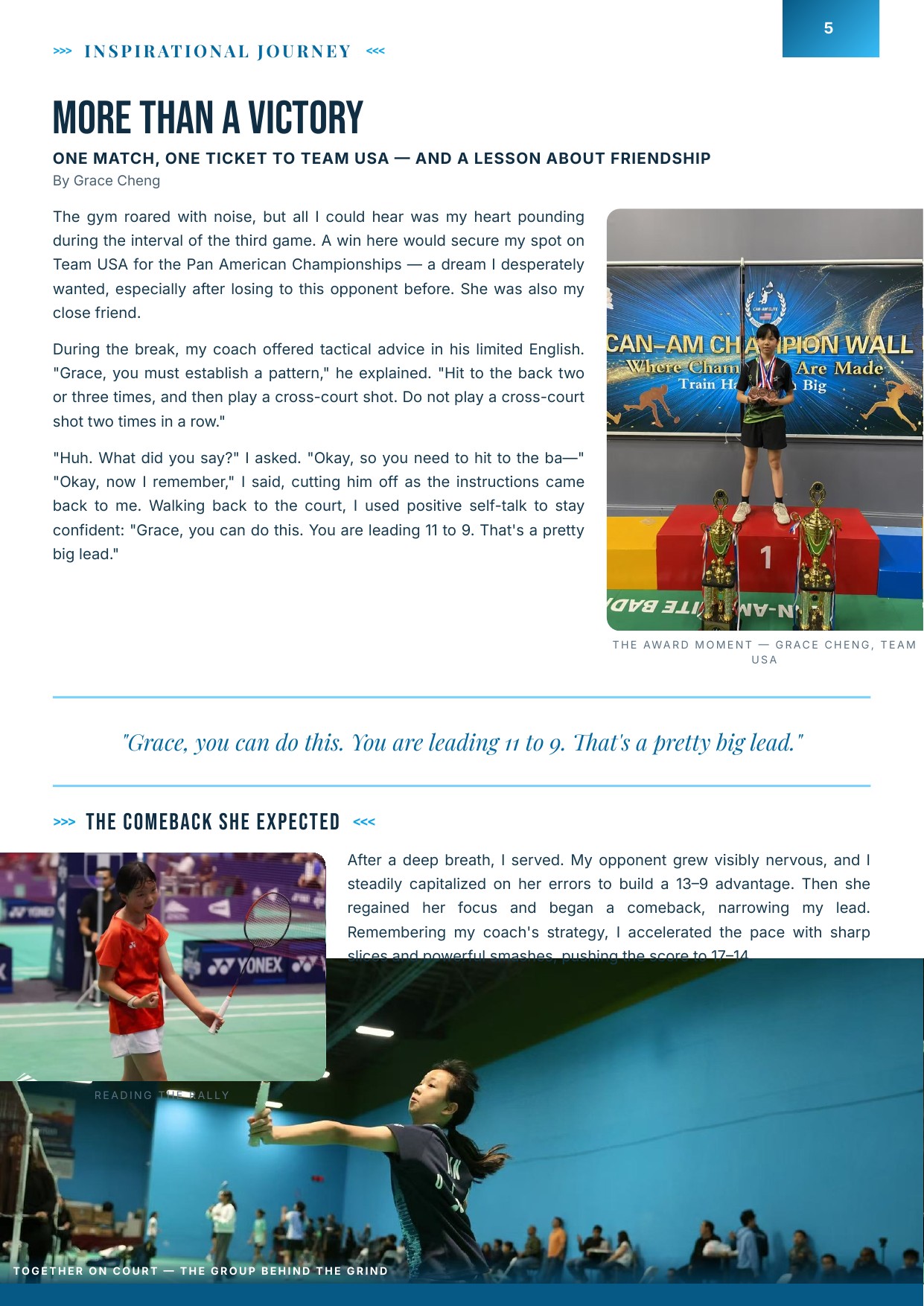
The gym roared with noise, but all I could hear was my heart pounding during the interval of the third game. A win here would secure my spot on Team USA for the Pan American Championships — a dream I desperately wanted, especially after losing to this opponent before. She was also my close friend.
During the break, my coach offered tactical advice in his limited English. "Grace, you must establish a pattern," he explained. "Hit to the back two or three times, and then play a cross-court shot. Do not play a cross-court shot two times in a row."
"Huh. What did you say?" I asked. "Okay, so you need to hit to the ba—" "Okay, now I remember," I said, cutting him off as the instructions came back to me. Walking back to the court, I used positive self-talk to stay confident: "Grace, you can do this. You are leading 11 to 9. That's a pretty big lead."
"Grace, you can do this. You are leading 11 to 9. That's a pretty big lead."
The Comeback She Expected
After a deep breath, I served. My opponent grew visibly nervous, and I steadily capitalized on her errors to build a 13–9 advantage. Then she regained her focus and began a comeback, narrowing my lead. Remembering my coach's strategy, I accelerated the pace with sharp slices and powerful smashes, pushing the score to 17–14.
Match Point — and After
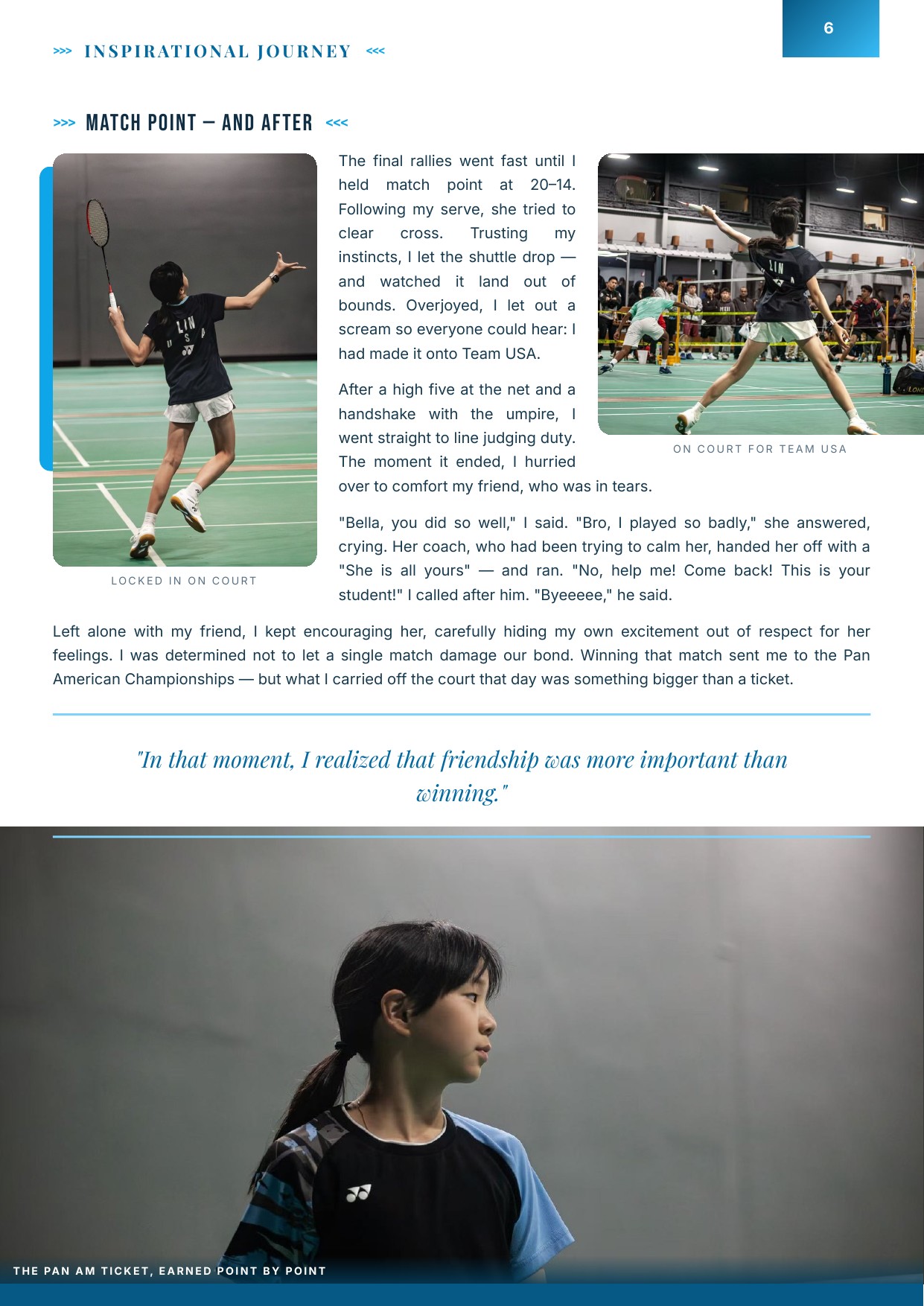
The final rallies went fast until I held match point at 20–14. Following my serve, she tried to clear cross. Trusting my instincts, I let the shuttle drop — and watched it land out of bounds. Overjoyed, I let out a scream so everyone could hear: I had made it onto Team USA.
After a high five at the net and a handshake with the umpire, I went straight to line judging duty. The moment it ended, I hurried over to comfort my friend, who was in tears.
"Bella, you did so well," I said. "Bro, I played so badly," she answered, crying. Her coach, who had been trying to calm her, handed her off with a "She is all yours" — and ran. "No, help me! Come back! This is your student!" I called after him. "Byeeeee," he said.
Left alone with my friend, I kept encouraging her, carefully hiding my own excitement out of respect for her feelings. I was determined not to let a single match damage our bond. Winning that match sent me to the Pan American Championships — but what I carried off the court that day was something bigger than a ticket.
❯❯❯ Inspirational ❮❮❮
"In that moment, I realized that friendship was more important than winning."
Inspirational Journey
More Than a Game
Injury, Doubt, and Deciding Whether a Passion Is Worth Coming Back To
By Xinyan (Grace) Zeng
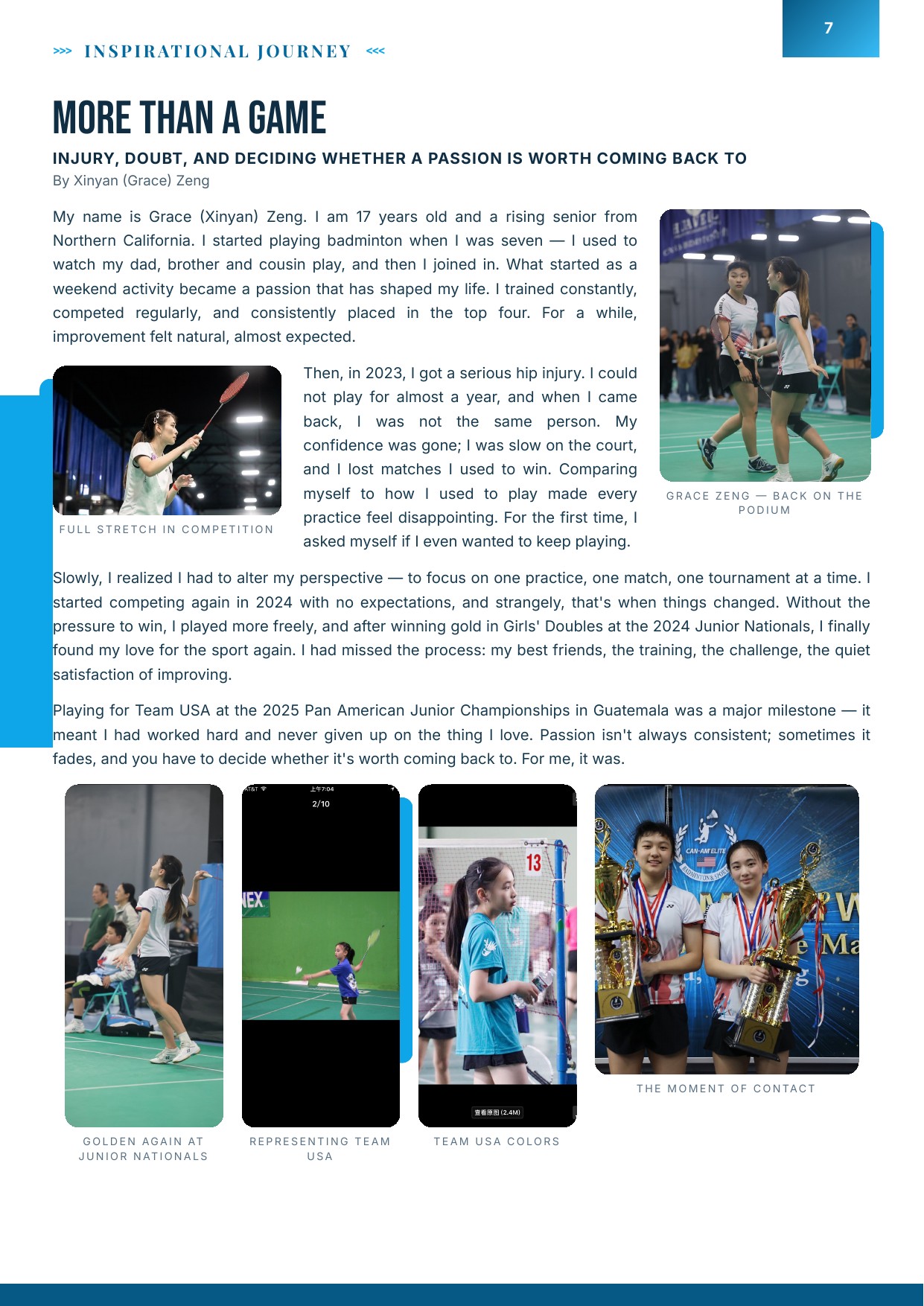
My name is Grace (Xinyan) Zeng. I am 17 years old and a rising senior from Northern California. I started playing badminton when I was seven — I used to watch my dad, brother and cousin play, and then I joined in. What started as a weekend activity became a passion that has shaped my life. I trained constantly, competed regularly, and consistently placed in the top four. For a while, improvement felt natural, almost expected.
Then, in 2023, I got a serious hip injury. I could not play for almost a year, and when I came back, I was not the same person. My confidence was gone; I was slow on the court, and I lost matches I used to win. Comparing myself to how I used to play made every practice feel disappointing. For the first time, I asked myself if I even wanted to keep playing.
Slowly, I realized I had to alter my perspective — to focus on one practice, one match, one tournament at a time. I started competing again in 2024 with no expectations, and strangely, that's when things changed. Without the pressure to win, I played more freely, and after winning gold in Girls' Doubles at the 2024 Junior Nationals, I finally found my love for the sport again. I had missed the process: my best friends, the training, the challenge, the quiet satisfaction of improving.
Playing for Team USA at the 2025 Pan American Junior Championships in Guatemala was a major milestone — it meant I had worked hard and never given up on the thing I love. Passion isn't always consistent; sometimes it fades, and you have to decide whether it's worth coming back to. For me, it was.
Inspirational Journey
Courtside to Podium
Junior National Champion · Pan Am Junior Qualifier · 2025 World Junior Championships
Featuring Jasmine Yeung
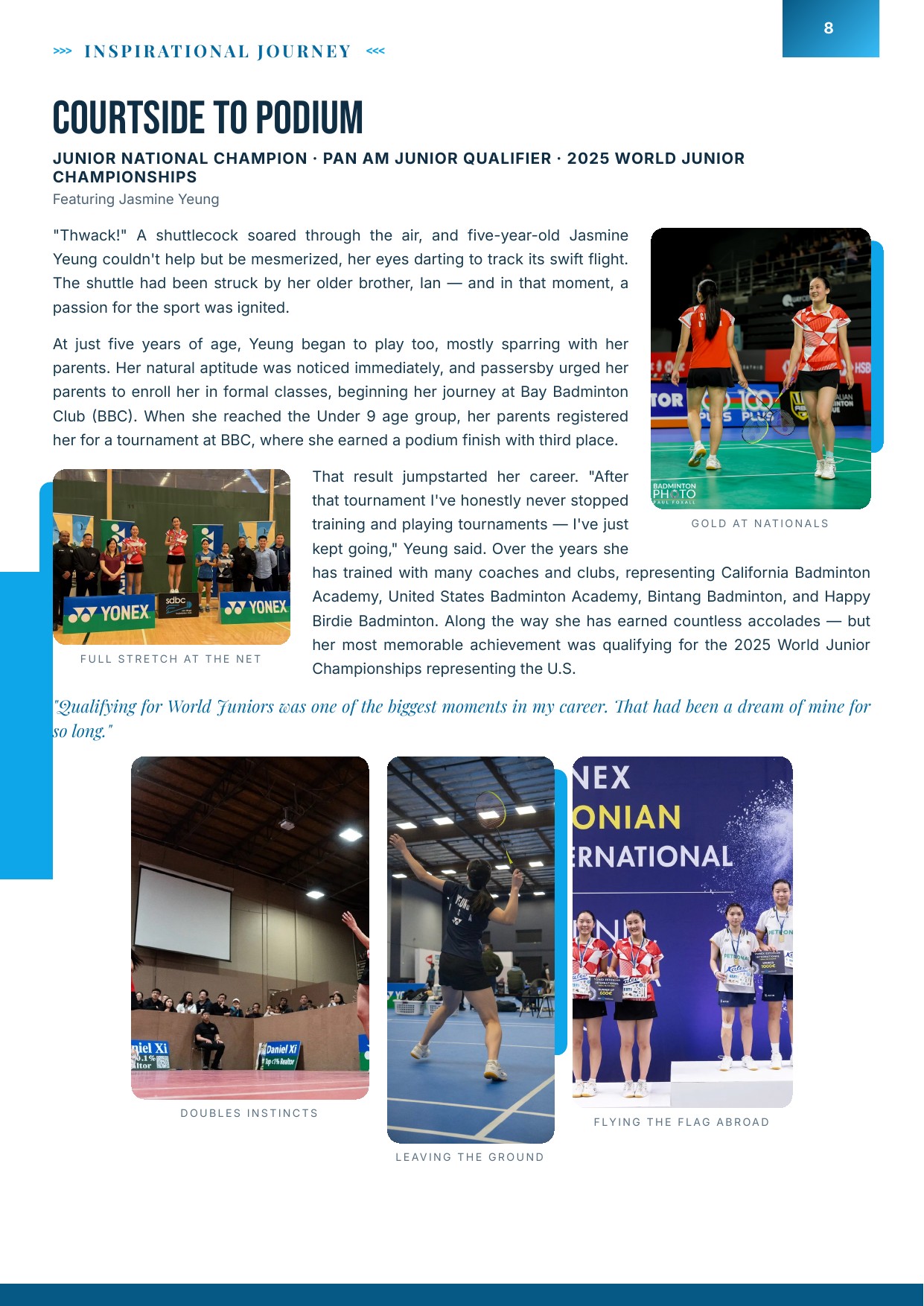
"Thwack!" A shuttlecock soared through the air, and five-year-old Jasmine Yeung couldn't help but be mesmerized, her eyes darting to track its swift flight. The shuttle had been struck by her older brother, Ian — and in that moment, a passion for the sport was ignited.
At just five years of age, Yeung began to play too, mostly sparring with her parents. Her natural aptitude was noticed immediately, and passersby urged her parents to enroll her in formal classes, beginning her journey at Bay Badminton Club (BBC). When she reached the Under 9 age group, her parents registered her for a tournament at BBC, where she earned a podium finish with third place.
That result jumpstarted her career. "After that tournament I've honestly never stopped training and playing tournaments — I've just kept going," Yeung said. Over the years she has trained with many coaches and clubs, representing California Badminton Academy, United States Badminton Academy, Bintang Badminton, and Happy Birdie Badminton. Along the way she has earned countless accolades — but her most memorable achievement was qualifying for the 2025 World Junior Championships representing the U.S.
"Qualifying for World Juniors was one of the biggest moments in my career. That had been a dream of mine for so long."
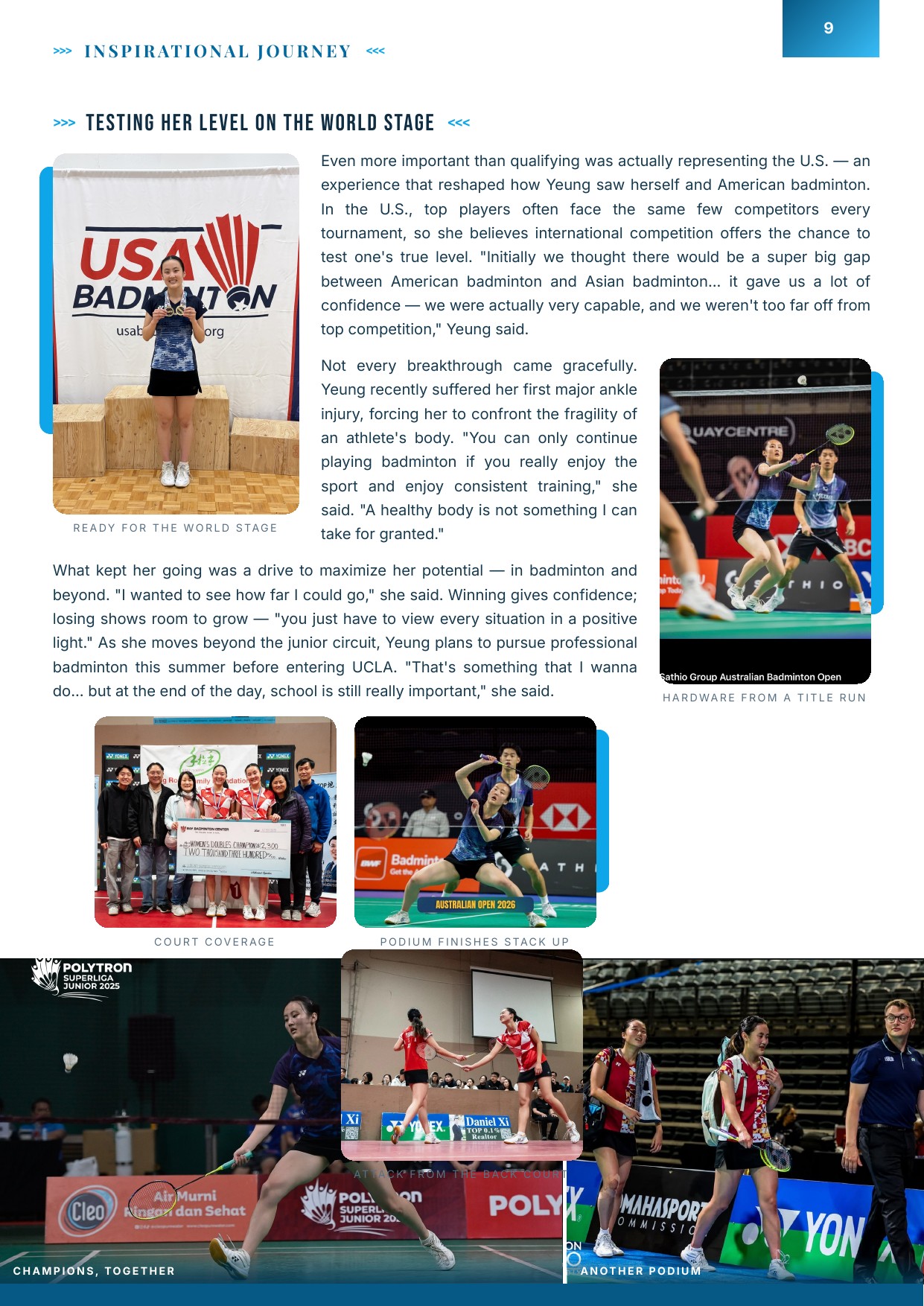
Testing Her Level on the World Stage
Even more important than qualifying was actually representing the U.S. — an experience that reshaped how Yeung saw herself and American badminton. In the U.S., top players often face the same few competitors every tournament, so she believes international competition offers the chance to test one's true level. "Initially we thought there would be a super big gap between American badminton and Asian badminton… it gave us a lot of confidence — we were actually very capable, and we weren't too far off from top competition," Yeung said.
Not every breakthrough came gracefully. Yeung recently suffered her first major ankle injury, forcing her to confront the fragility of an athlete's body. "You can only continue playing badminton if you really enjoy the sport and enjoy consistent training," she said. "A healthy body is not something I can take for granted."
What kept her going was a drive to maximize her potential — in badminton and beyond. "I wanted to see how far I could go," she said. Winning gives confidence; losing shows room to grow — "you just have to view every situation in a positive light." As she moves beyond the junior circuit, Yeung plans to pursue professional badminton this summer before entering UCLA. "That's something that I wanna do… but at the end of the day, school is still really important," she said.
Inspirational Journey
Beyond "Slow Mode"
2025 Pan Am Junior Qualifier · Junior Nationals Boys' Singles, 2nd Place
By Kevin Zhang
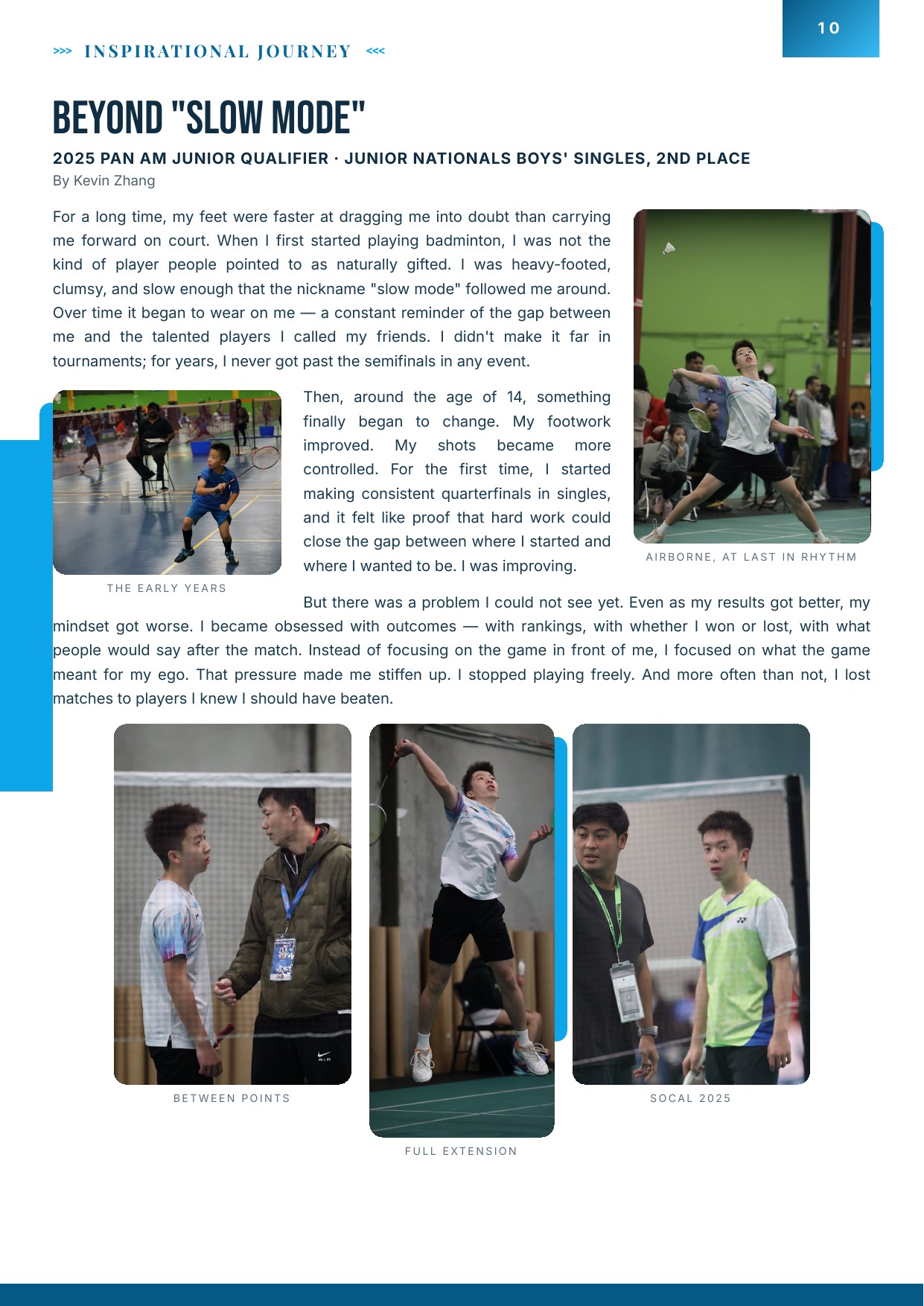
For a long time, my feet were faster at dragging me into doubt than carrying me forward on court. When I first started playing badminton, I was not the kind of player people pointed to as naturally gifted. I was heavy-footed, clumsy, and slow enough that the nickname "slow mode" followed me around. Over time it began to wear on me — a constant reminder of the gap between me and the talented players I called my friends. I didn't make it far in tournaments; for years, I never got past the semifinals in any event.
Then, around the age of 14, something finally began to change. My footwork improved. My shots became more controlled. For the first time, I started making consistent quarterfinals in singles, and it felt like proof that hard work could close the gap between where I started and where I wanted to be. I was improving.
But there was a problem I could not see yet. Even as my results got better, my mindset got worse. I became obsessed with outcomes — with rankings, with whether I won or lost, with what people would say after the match. Instead of focusing on the game in front of me, I focused on what the game meant for my ego. That pressure made me stiffen up. I stopped playing freely. And more often than not, I lost matches to players I knew I should have beaten.
When I Stopped Chasing the Scoreboard
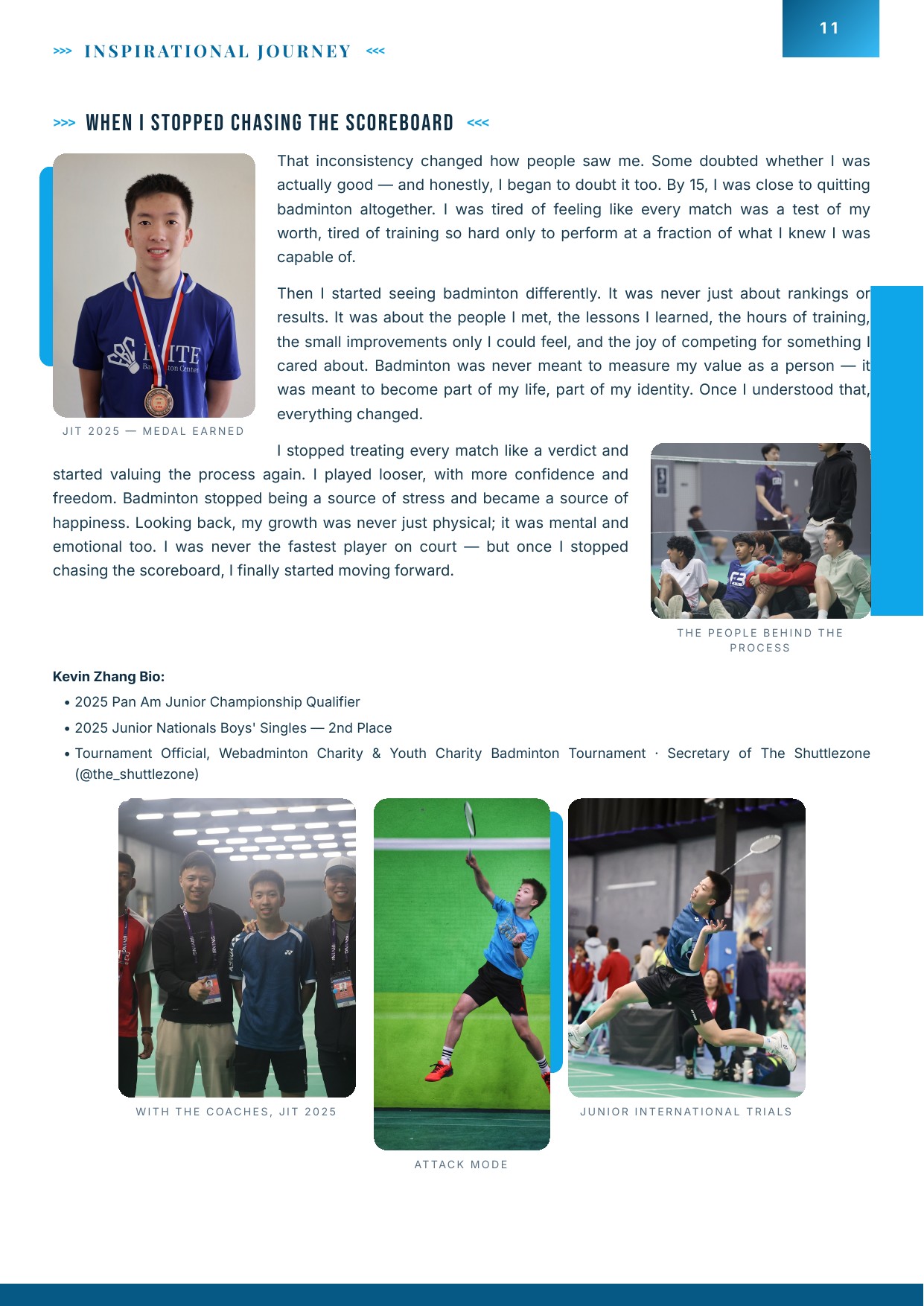
That inconsistency changed how people saw me. Some doubted whether I was actually good — and honestly, I began to doubt it too. By 15, I was close to quitting badminton altogether. I was tired of feeling like every match was a test of my worth, tired of training so hard only to perform at a fraction of what I knew I was capable of.
Then I started seeing badminton differently. It was never just about rankings or results. It was about the people I met, the lessons I learned, the hours of training, the small improvements only I could feel, and the joy of competing for something I cared about. Badminton was never meant to measure my value as a person — it was meant to become part of my life, part of my identity. Once I understood that, everything changed.
I stopped treating every match like a verdict and started valuing the process again. I played looser, with more confidence and freedom. Badminton stopped being a source of stress and became a source of happiness. Looking back, my growth was never just physical; it was mental and emotional too. I was never the fastest player on court — but once I stopped chasing the scoreboard, I finally started moving forward.
Kevin Zhang Bio
- 2025 Pan Am Junior Championship Qualifier
- 2025 Junior Nationals Boys' Singles — 2nd Place
- Tournament Official, Webadminton Charity & Youth Charity Badminton Tournament · Secretary of The Shuttlezone (@the_shuttlezone)
Inspirational Journey
Driving Excellence On and Off the Court
How a 17-Year-Old from Irvine Turned Patience into a Game Plan — and a Platform
Featuring Zicheng (Josh) Xu
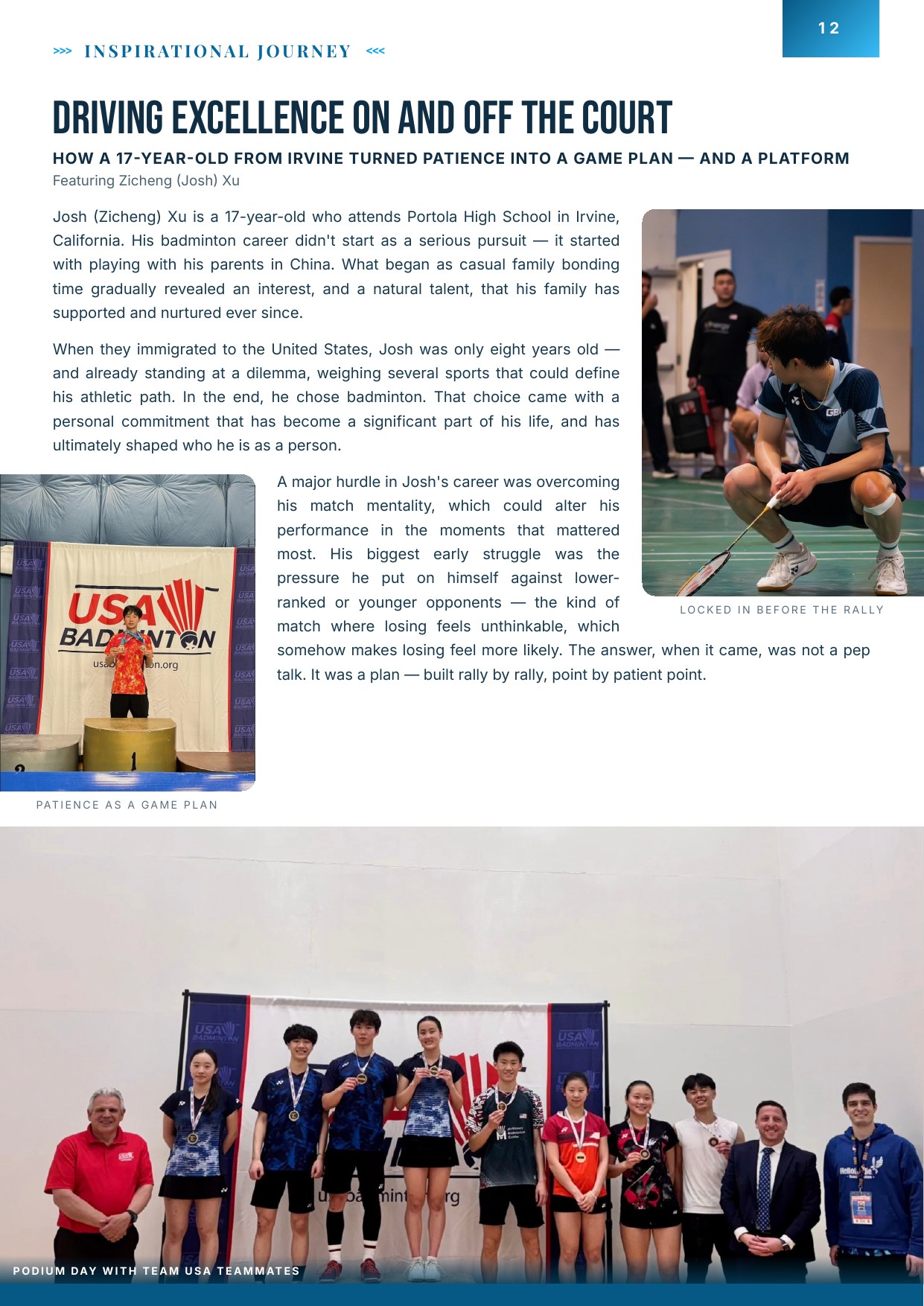
Josh (Zicheng) Xu is a 17-year-old who attends Portola High School in Irvine, California. His badminton career didn't start as a serious pursuit — it started with playing with his parents in China. What began as casual family bonding time gradually revealed an interest, and a natural talent, that his family has supported and nurtured ever since.
When they immigrated to the United States, Josh was only eight years old — and already standing at a dilemma, weighing several sports that could define his athletic path. In the end, he chose badminton. That choice came with a personal commitment that has become a significant part of his life, and has ultimately shaped who he is as a person.
A major hurdle in Josh's career was overcoming his match mentality, which could alter his performance in the moments that mattered most. His biggest early struggle was the pressure he put on himself against lower-ranked or younger opponents — the kind of match where losing feels unthinkable, which somehow makes losing feel more likely. The answer, when it came, was not a pep talk. It was a plan — built rally by rally, point by patient point.
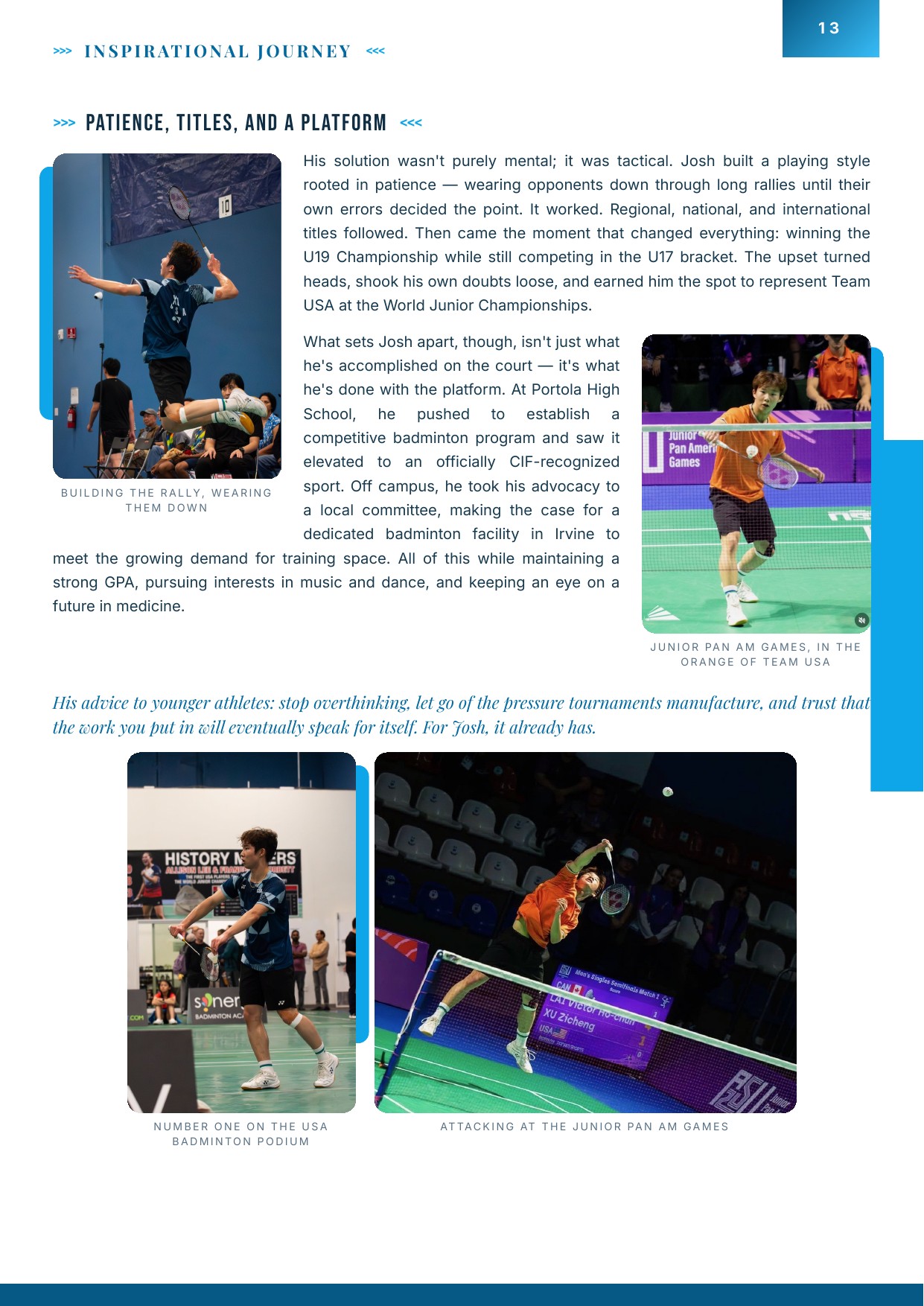
Patience, Titles, and a Platform
His solution wasn't purely mental; it was tactical. Josh built a playing style rooted in patience — wearing opponents down through long rallies until their own errors decided the point. It worked. Regional, national, and international titles followed. Then came the moment that changed everything: winning the U19 Championship while still competing in the U17 bracket. The upset turned heads, shook his own doubts loose, and earned him the spot to represent Team USA at the World Junior Championships.
What sets Josh apart, though, isn't just what he's accomplished on the court — it's what he's done with the platform. At Portola High School, he pushed to establish a competitive badminton program and saw it elevated to an officially CIF-recognized sport. Off campus, he took his advocacy to a local committee, making the case for a dedicated badminton facility in Irvine to meet the growing demand for training space. All of this while maintaining a strong GPA, pursuing interests in music and dance, and keeping an eye on a future in medicine.
❯❯❯ Inspirational ❮❮❮
His advice to younger athletes: stop overthinking, let go of the pressure tournaments manufacture, and trust that the work you put in will eventually speak for itself. For Josh, it already has.
Inspirational Journey
Third Time for Team USA
Bronze in Mexico, Bronze in Guatemala — a U15 Player Winning Against Older Opponents
By Janice Chen
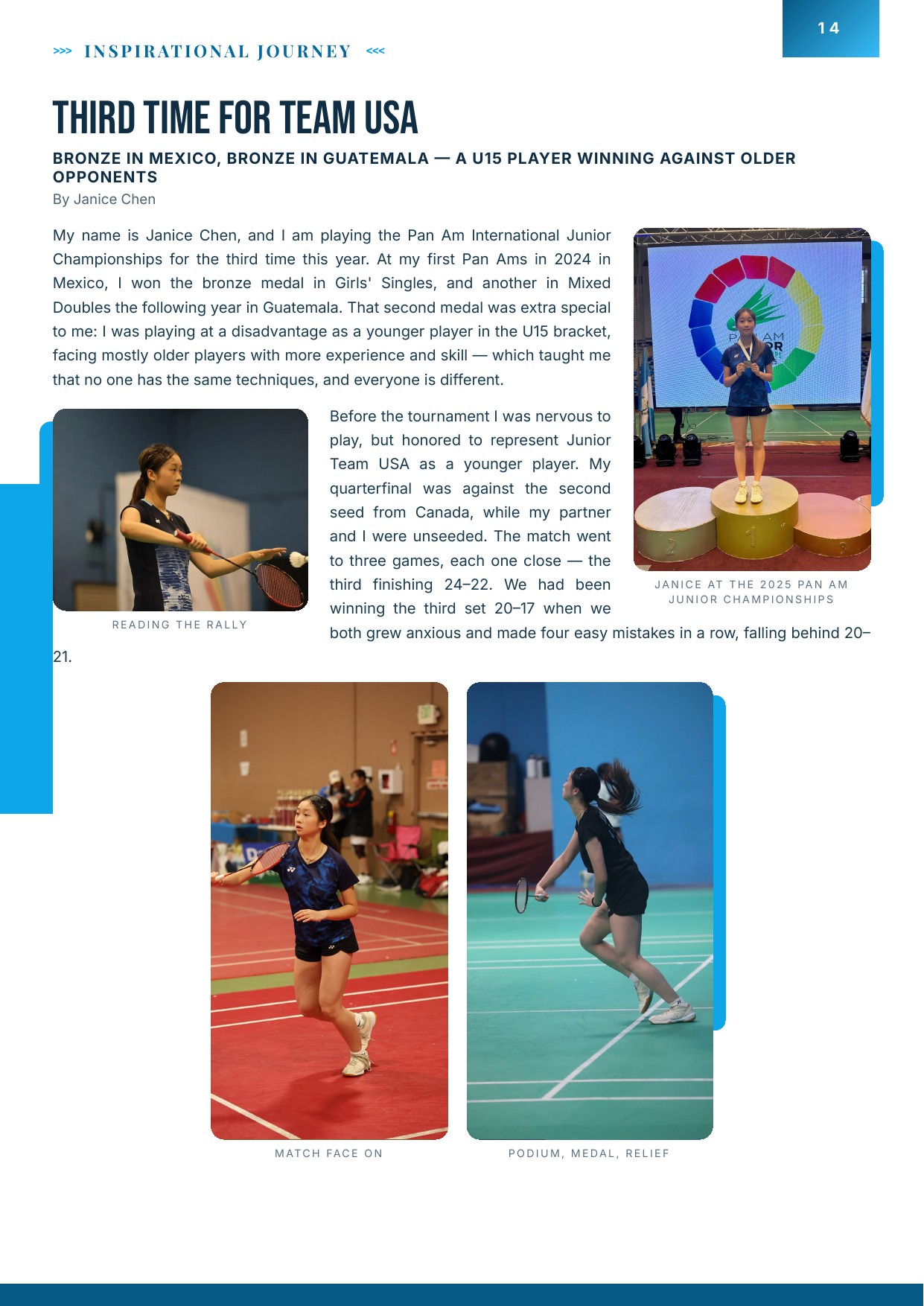
My name is Janice Chen, and I am playing the Pan Am International Junior Championships for the third time this year. At my first Pan Ams in 2024 in Mexico, I won the bronze medal in Girls' Singles, and another in Mixed Doubles the following year in Guatemala. That second medal was extra special to me: I was playing at a disadvantage as a younger player in the U15 bracket, facing mostly older players with more experience and skill — which taught me that no one has the same techniques, and everyone is different.
Before the tournament I was nervous to play, but honored to represent Junior Team USA as a younger player. My quarterfinal was against the second seed from Canada, while my partner and I were unseeded. The match went to three games, each one close — the third finishing 24–22. We had been winning the third set 20–17 when we both grew anxious and made four easy mistakes in a row, falling behind 20–21.
Flow State at Match Point
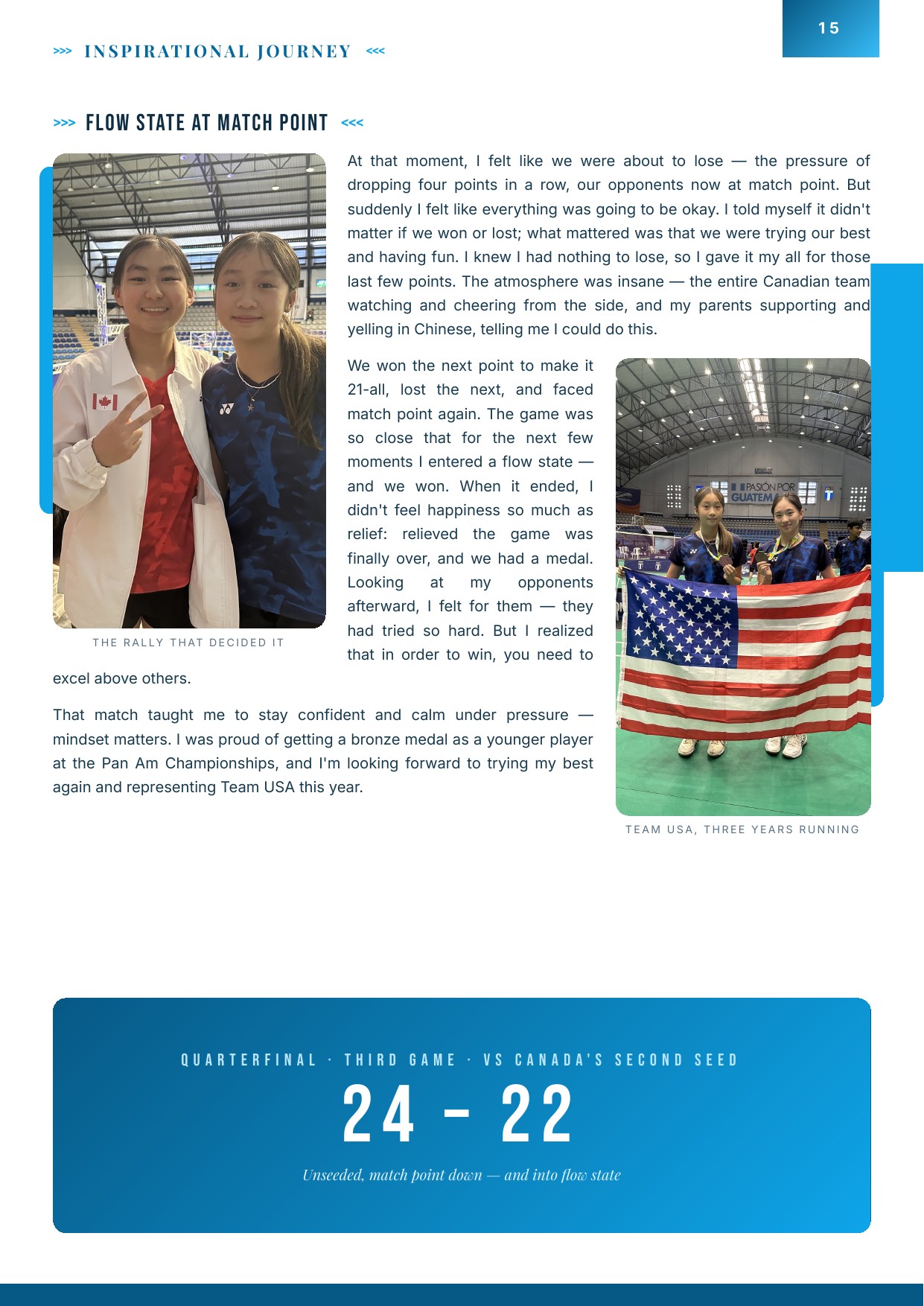
At that moment, I felt like we were about to lose — the pressure of dropping four points in a row, our opponents now at match point. But suddenly I felt like everything was going to be okay. I told myself it didn't matter if we won or lost; what mattered was that we were trying our best and having fun. I knew I had nothing to lose, so I gave it my all for those last few points. The atmosphere was insane — the entire Canadian team watching and cheering from the side, and my parents supporting and yelling in Chinese, telling me I could do this.
We won the next point to make it 21-all, lost the next, and faced match point again. The game was so close that for the next few moments I entered a flow state — and we won. When it ended, I didn't feel happiness so much as relief: relieved the game was finally over, and we had a medal. Looking at my opponents afterward, I felt for them — they had tried so hard. But I realized that in order to win, you need to excel above others.
That match taught me to stay confident and calm under pressure — mindset matters. I was proud of getting a bronze medal as a younger player at the Pan Am Championships, and I'm looking forward to trying my best again and representing Team USA this year.
Quarterfinal · Third Game · vs Canada's Second Seed
24 – 22
Unseeded, match point down — and into flow state
Rising Stars
The Balance of Academics and Badminton
A SoCal Doubles Specialist — and Future Stanford Student — on Never Settling
Featuring Youshi (Tiger) Chen
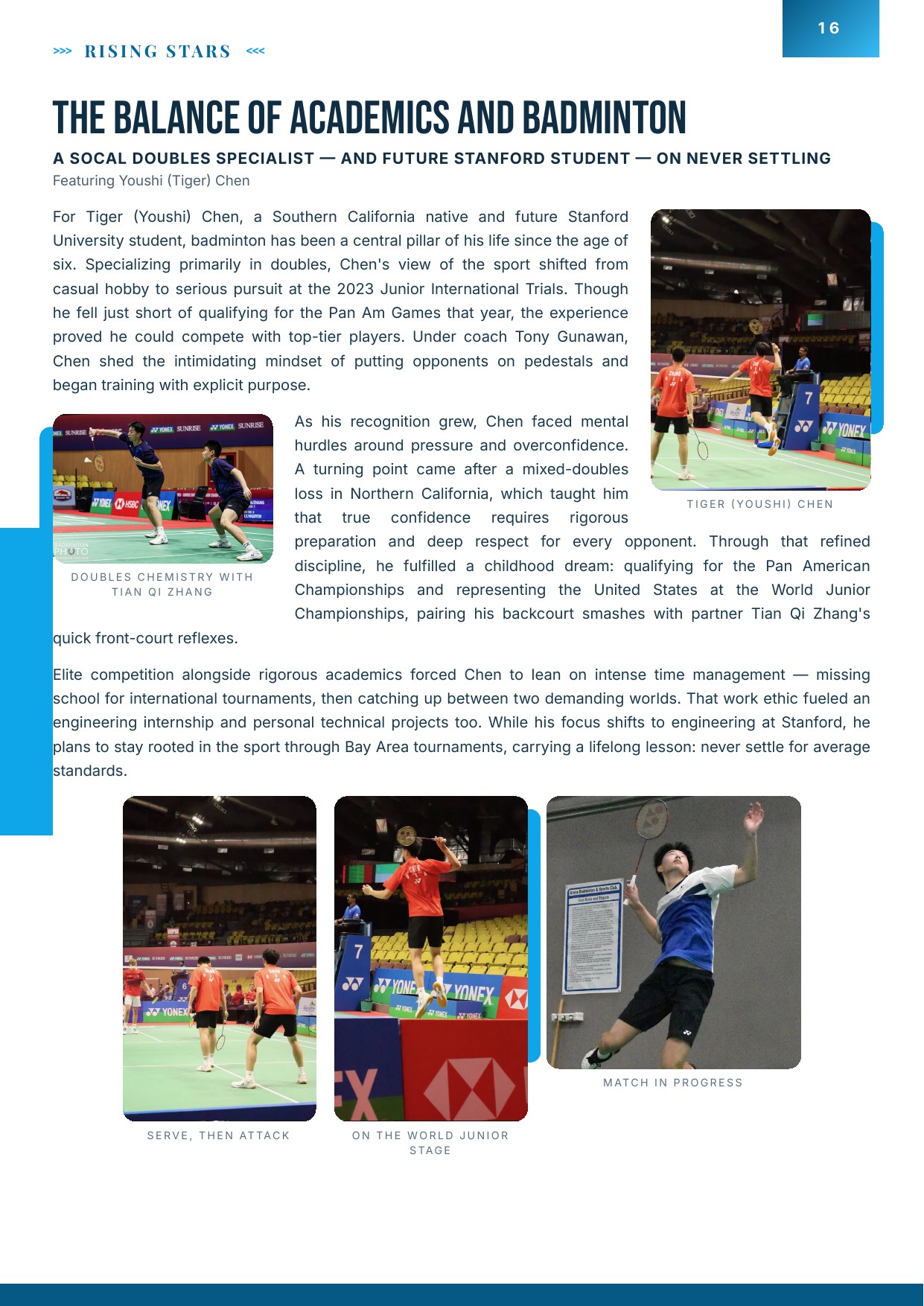
For Tiger (Youshi) Chen, a Southern California native and future Stanford University student, badminton has been a central pillar of his life since the age of six. Specializing primarily in doubles, Chen's view of the sport shifted from casual hobby to serious pursuit at the 2023 Junior International Trials. Though he fell just short of qualifying for the Pan Am Games that year, the experience proved he could compete with top-tier players. Under coach Tony Gunawan, Chen shed the intimidating mindset of putting opponents on pedestals and began training with explicit purpose.
As his recognition grew, Chen faced mental hurdles around pressure and overconfidence. A turning point came after a mixed-doubles loss in Northern California, which taught him that true confidence requires rigorous preparation and deep respect for every opponent. Through that refined discipline, he fulfilled a childhood dream: qualifying for the Pan American Championships and representing the United States at the World Junior Championships, pairing his backcourt smashes with partner Tian Qi Zhang's quick front-court reflexes.
Elite competition alongside rigorous academics forced Chen to lean on intense time management — missing school for international tournaments, then catching up between two demanding worlds. That work ethic fueled an engineering internship and personal technical projects too. While his focus shifts to engineering at Stanford, he plans to stay rooted in the sport through Bay Area tournaments, carrying a lifelong lesson: never settle for average standards.
Rising Stars
From Perseverance to Leadership
Nine Years of Quiet Progress, a Breakthrough Gold — and a Junior National Title
Featuring Adhyaan Balaji
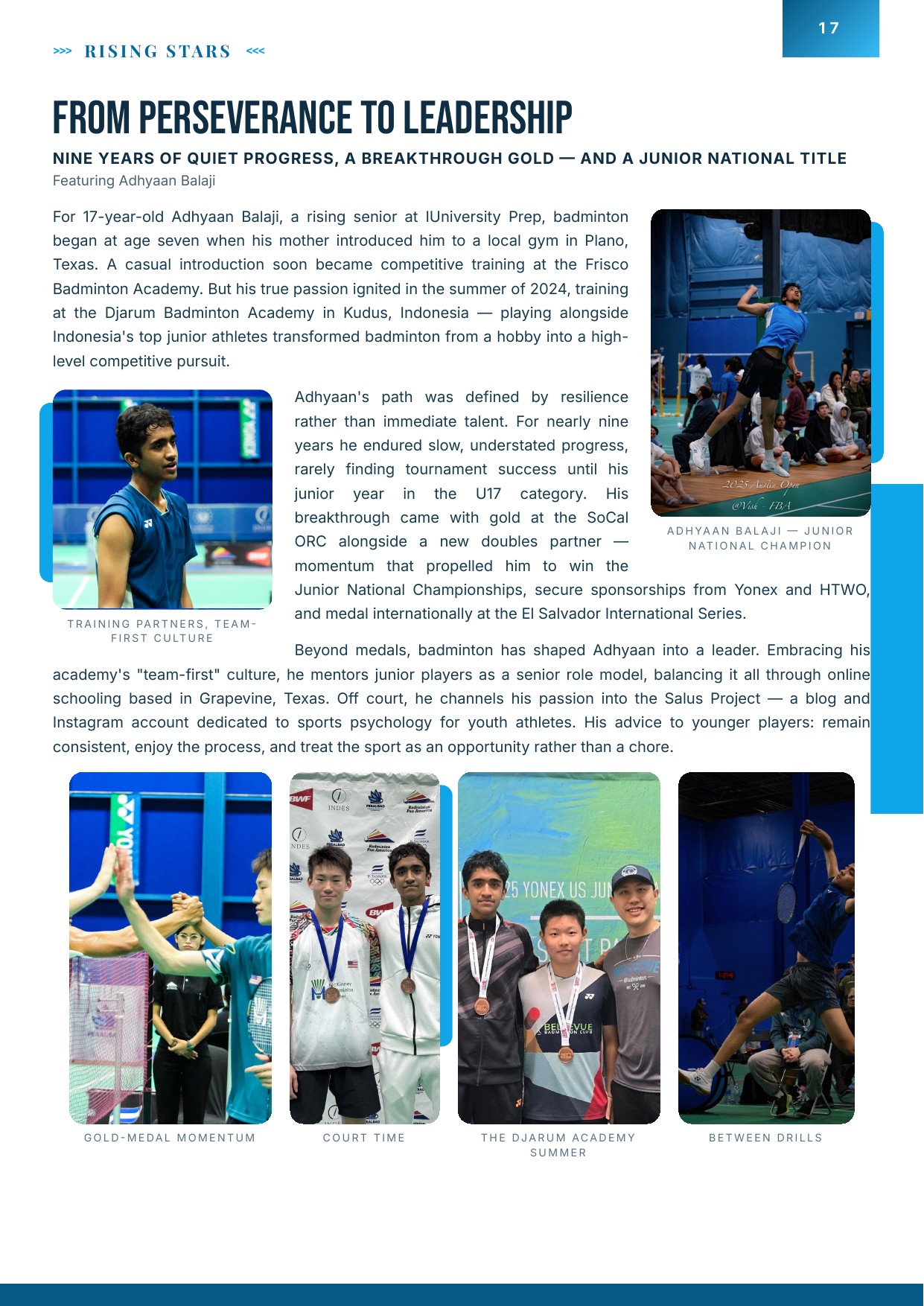
For 17-year-old Adhyaan Balaji, a rising senior at IUniversity Prep, badminton began at age seven when his mother introduced him to a local gym in Plano, Texas. A casual introduction soon became competitive training at the Frisco Badminton Academy. But his true passion ignited in the summer of 2024, training at the Djarum Badminton Academy in Kudus, Indonesia — playing alongside Indonesia's top junior athletes transformed badminton from a hobby into a high-level competitive pursuit.
Adhyaan's path was defined by resilience rather than immediate talent. For nearly nine years he endured slow, understated progress, rarely finding tournament success until his junior year in the U17 category. His breakthrough came with gold at the SoCal ORC alongside a new doubles partner — momentum that propelled him to win the Junior National Championships, secure sponsorships from Yonex and HTWO, and medal internationally at the El Salvador International Series.
Beyond medals, badminton has shaped Adhyaan into a leader. Embracing his academy's "team-first" culture, he mentors junior players as a senior role model, balancing it all through online schooling based in Grapevine, Texas. Off court, he channels his passion into the Salus Project — a blog and Instagram account dedicated to sports psychology for youth athletes. His advice to younger players: remain consistent, enjoy the process, and treat the sport as an opportunity rather than a chore.
Rising Stars
Journey of a Young Athlete
From a Pandemic Pastime to Midwest Badminton — Thinking a Few Shots Ahead
Featuring Melvin Cui
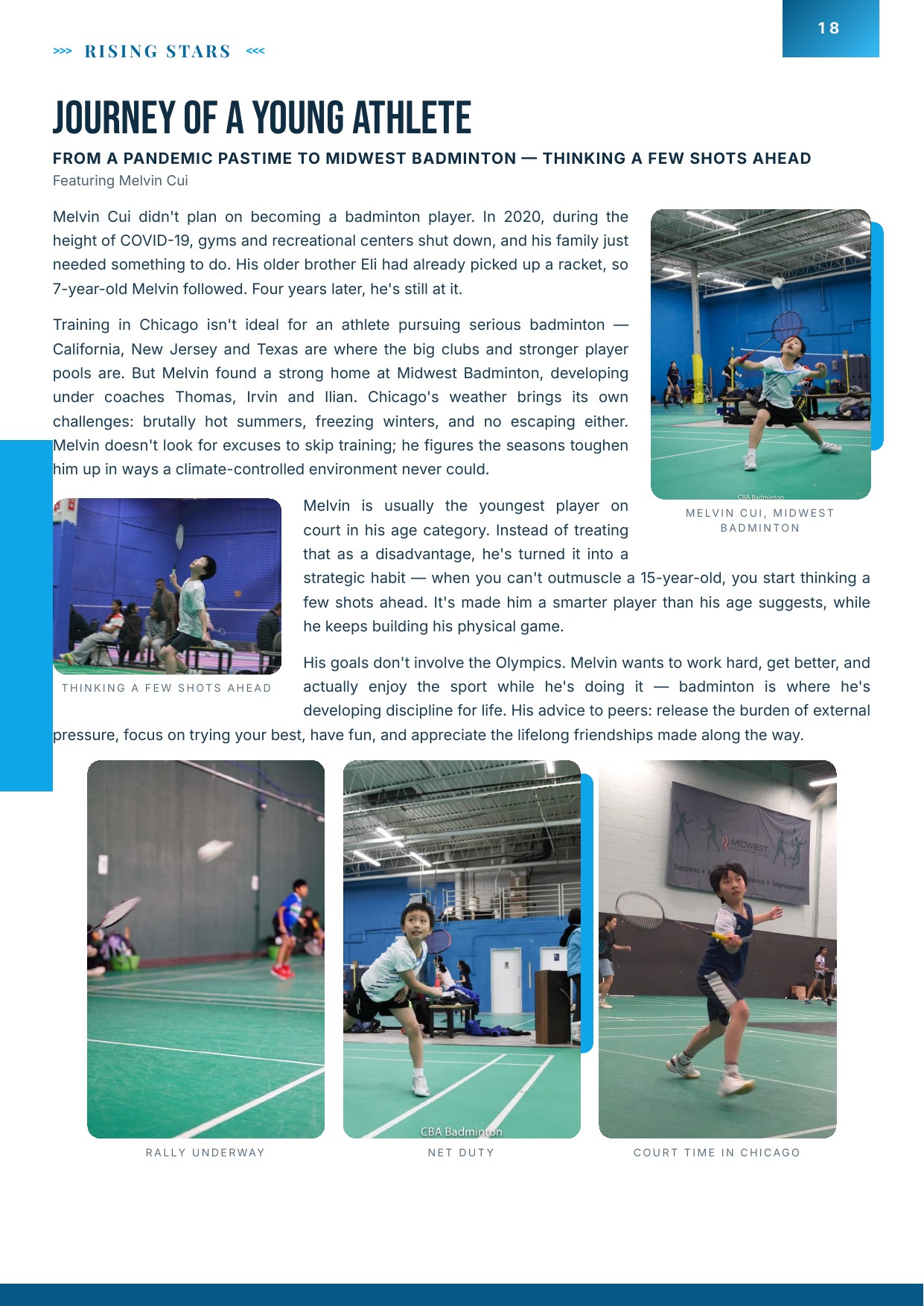
Melvin Cui didn't plan on becoming a badminton player. In 2020, during the height of COVID-19, gyms and recreational centers shut down, and his family just needed something to do. His older brother Eli had already picked up a racket, so 7-year-old Melvin followed. Four years later, he's still at it.
Training in Chicago isn't ideal for an athlete pursuing serious badminton — California, New Jersey and Texas are where the big clubs and stronger player pools are. But Melvin found a strong home at Midwest Badminton, developing under coaches Thomas, Irvin and Ilian. Chicago's weather brings its own challenges: brutally hot summers, freezing winters, and no escaping either. Melvin doesn't look for excuses to skip training; he figures the seasons toughen him up in ways a climate-controlled environment never could.
Melvin is usually the youngest player on court in his age category. Instead of treating that as a disadvantage, he's turned it into a strategic habit — when you can't outmuscle a 15-year-old, you start thinking a few shots ahead. It's made him a smarter player than his age suggests, while he keeps building his physical game.
His goals don't involve the Olympics. Melvin wants to work hard, get better, and actually enjoy the sport while he's doing it — badminton is where he's developing discipline for life. His advice to peers: release the burden of external pressure, focus on trying your best, have fun, and appreciate the lifelong friendships made along the way.
Masthead
- Editor-in-Chief: Hao Lin
- Editorial Team: Xinyan (Grace) Zeng, Andy Zhang, Tao Cheng, Camellia Wang
- Advisory Board: Matt Zhou, Hellen Guo, Dean Schoppe, David Levin, Cora Tanuwidjaja, Tao Cheng, Hong Li
- Contributors: Grace Cheng, Jasmine Yeung, Kevin Zhang, Zicheng (Josh) Xu, Janice Chen, Youshi (Tiger) Chen, Adhyaan Balaji, Melvin Cui
With thanks to featured coaches Hendry Winarto and Rong Schafer, and to all athletes, families and clubs for sharing their stories and photographs.